

The most significant challenge for major internet platforms dealing with payments is the hidden cost associated with the account funding process. What looks like a seamless experience for the end user is actually built on a fragmented, brittle stack of ACH rails, card processors, local payment methods, crypto on-ramps, compliance workflows, and manual reconciliation. When a platform attempts to scale across international borders and diverse asset classes, this infrastructure inevitably becomes a bottleneck that restricts growth.
The most ambitious platforms in fintech, crypto trading, gaming, and consumer finance all hit a ceiling when their growth outpaces their underlying payments infrastructure. This is a unique challenge because, unlike typical software scaling issues, the complexity of managing payments actually intensifies as transaction volume grows. As these companies expand into new geographies and asset types, and support more diverse user behaviors and edge cases, the technical debt compounds and begins to threaten conversion rates. At this point, maintaining an in-house payments system often feels like running an entirely separate company within the primary business.
This is exactly the challenge that Fun was built to solve, and why we're excited to co-lead their $72 million Series A, alongside Multicoin Capital.
A deceptively simple product solving a deeply complex problem
Fun is building the payments infrastructure layer for the world's fastest-growing fintech platforms. At its core, the product is a unified deposit and withdrawal experience that works across fiat, stablecoins, and crypto rails. Under the hood, it is considerably more complex. Fun dynamically routes every transaction in real time across geographies, currencies, asset types, and payment paths based on what converts best for that specific user at that moment.
The end user only sees a single clean interface, and that abstraction is the point. Fun obsesses over every detail of the deposit and withdrawal experience, including load times, regional behavior patterns, and edge cases at scale, so its customers don't have to and their users have a delightful experience.
The results speak for themselves. Polymarket, one of the largest prediction markets in the world and Fun's marquee customer, calls it the highest-converting, most reliable deposit-and-withdrawal flow they've ever run. At Polymarket’s scale, every percentage point of conversion is worth millions of dollars and users.
Why does this problem matter right now?
Payments infrastructure has not kept up with a fundamental shift in how global fintechs and internet-native businesses operate, and traditional payment rails were not designed for this.
At the same time, stablecoins have matured into a reliable backend settlement layer for global value transfer, with annual transaction volumes now running into the trillions. Most end users still expect a fiat experience, but under the hood, platforms are increasingly comfortable using stablecoins to move value globally at a lower cost and higher speed than traditional rails allow. Broader stablecoin adoption expands the surface area for orchestration infrastructure rather than replacing it—the more rails that exist, the more valuable a unified routing layer becomes.
The regulatory environment is catching up as well. The shift toward crypto-friendly policy in the U.S. has accelerated enterprise adoption meaningfully, with companies like Meta, Stripe, and Shopify all adding crypto payment rails over the past year.
The implication is straightforward: if you can't get money on and off chain seamlessly, you can't build and scale internet capital markets. Fun is the infrastructure that makes this possible, abstracting the complexity of fiat, stablecoin, and crypto rails into a single high-converting payments layer that platforms can integrate without rebuilding their stack.
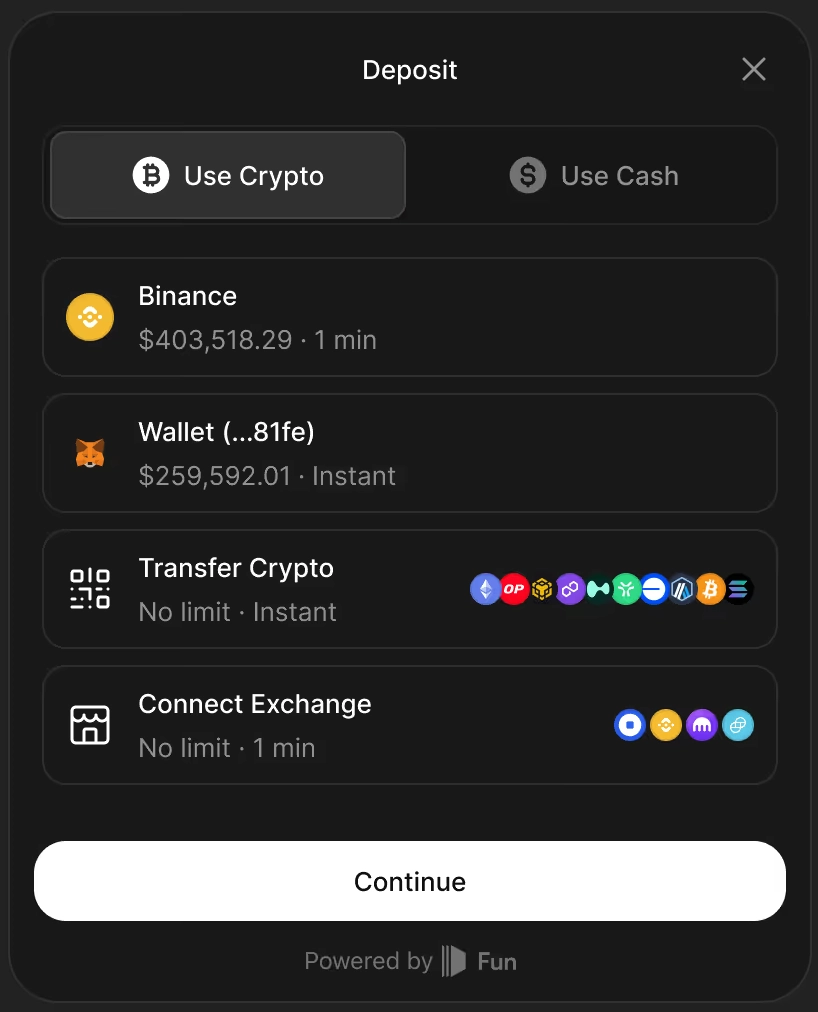
Fun’s deposit flow
The market opportunity extends far beyond crypto
While early adoption is concentrated among blockchain-first companies such as perpetual exchanges, prediction markets, and crypto gaming, the underlying friction is not unique to that world. The same payment problems exist everywhere that money moves, at scale, across borders:
- B2B fintechs that are expanding internationally
- Online gaming platforms that need global, high-conversion funding flows
- Stablecoin neobanks that serve under-banked populations across emerging markets
- TradFi exchanges and payroll platforms by stitching together domestic and cross-border rails
- Global commerce players that manage dozens of local payment methods simultaneously
These categories, which collectively represent tens of trillions in annual payment volume, are mostly running on infrastructure built for a slower, more fragmented world. The opportunity is to become the default payments layer across all of them as stablecoin-based settlement becomes normalized at the enterprise level. Fun's architecture was built with exactly that goal in mind.
Proven at extreme scale with a model that compounds
Fun reports that they’re already processing over $18 billion in annual transaction volume across more than 100 countries with a 99.99% uptime record. This level of reliability is particularly impressive because it represents a performance standard that most legacy enterprise payments vendors struggle to achieve.
The company has more than 20 customers, including marquee names such as Polymarket, Lighter, and Aave.
Fun competes primarily with internal builds, as most platforms initially think they can stitch together deposit and withdrawal flows in-house. But once they start to scale, these patchwork solutions often break, and engineering teams that should be building core products are busy maintaining their “payment plumbing” instead.
Many of Fun's customers have been through this exact experience. Replicating Fun's routing logic and operational maturity is non-trivial even for well-resourced teams, and for platforms where payments are critical, but non-differentiating, the build-vs-buy calculus shifts decisively.
What makes Fun's infrastructure more durable than a series of one-off integrations is the network dynamics that underpin it. New customers bring new geographies, currencies, user behaviors, and edge cases to Fun's routing system. That data improves performance across the entire network, which makes every subsequent customer integration better than the last. That compounding improvement is already visible in how Fun acquires customers. Polymarket's deposit experience has become a de facto showcase, and multiple prospective customers have independently sought out Fun after experiencing that flow firsthand, even without any formal marketing or outbound from Fun's team.
"Polymarket runs at a scale that breaks most payments infrastructure. We've evaluated every major payments vendor, and Fun is in a different category. They operate like a part of our team, building custom flows around how our users actually behave. They are meticulous about every detail and solve edge cases that others don't notice. At our size, every percentage point of conversion is millions of dollars and millions of users, and every reliability failure becomes a public conversation. Bespoke engineering is the only way to deliver results, and it's how Fun has built the highest-converting, most reliable deposit flow we've ever run."
- Josh Stevens, VP of Engineering, Polymarket
Why Fun fits the SignalFire thesis
At SignalFire, we are always looking to invest in infrastructure companies that solve deep technical challenges in markets that have been historically underserved. The payment systems for high-velocity, global internet platforms fit this description perfectly and represent the kind of foundational problems we are most excited to back.
Using our proprietary AI platform, Beacon, we track where the fastest-growing companies in fintech and consumer internet are hitting operational ceilings, and payments infrastructure has consistently emerged as one of the sharpest pain points.
We have long maintained the conviction that crypto and stablecoins represent a fundamental evolution in how both consumers and businesses move money globally. The fact that digital asset settlement is now powering some of the world's highest-velocity platforms, often quite invisibly, is a clear indication that this technology is maturing into mainstream financial infrastructure. Fun is positioned at the very center of this transition as these methods become the standard for the modern economy.
Beyond capital, SignalFire has a fintech and enterprise network that is directly relevant to where Fun is headed. We offer dedicated GTM and Talent support, as well as Beacon, our proprietary talent platform, both of which will be critical as Fun continues to scale its engineering team to match the ambition of its product roadmap.
We are proud to partner with Alex and the Fun team as they build the payments layer for the next generation of financial services. If you're building a global platform where payment performance directly determines user growth, learn more at fun.xyz.
*Portfolio company founders listed above have not received any compensation for this feedback and may or may not have invested in a SignalFire fund. These founders may or may not serve as Affiliate Advisors, Retained Advisors, or consultants to provide their expertise on a formal or ad hoc basis. They are not employed by SignalFire and do not provide investment advisory services to clients on behalf of SignalFire. Please refer to our disclosures page for additional disclosures.
Related posts
How Patlytics is automating the hardest workflows in intellectual property
Why the future of Fintech belongs to industry-specific financial tools
Mega AI is leveling the playing field for SMBs with its AI growth engine
