Flatter, leaner, more technical: The new shape of tech companies in 2026
The tech company of 2021 was built for an era of abundance: cheap capital, hyper-scaled hiring, endless coordination layers, and highly specialized micro-roles. The tech company of 2026 is being rebuilt for leverage.
For the last five years, the story about AI and software jobs has been the same: coding assistants would first come for engineers, gutting the profession from the bottom up. In reality, the last 15 months of talent and hiring data show that the long-feared "AI Code Apocalypse" has failed to materialize.
While tech hiring overall has stalled at 75% of its pre-pandemic baseline, engineering has held up better than nearly every other function at the Tech Majors*. Design, product, and marketing did not, and the on-ramp that fed new graduates into the industry is narrower than ever.
Current market data reveals an entirely different structural reset. The lean tech company of 2026 isn’t just smaller, it’s a senior-heavy engineering core with the support structure stripped out around it. The latest tech layoffs are a structural purge of the organizational scaffolding that grew up around them during the zero-interest-rate policy (ZIRP) era.
As AI reshapes the tech landscape, organizations are cutting coordination layers, shattering the traditional career ladder, and forcing a massive shift from craft specialization to systems leverage.
Here are the shifts that matter:
- Overall, tech hiring is down, but the “AI Code Apocalypse” heavily impacted designers and marketers, while engineers were among the least impacted
- Hiring at the large tech companies is running at 25% below the 2019 baseline (on a trailing-12-month basis), the lowest level since the huge 2023 crash.
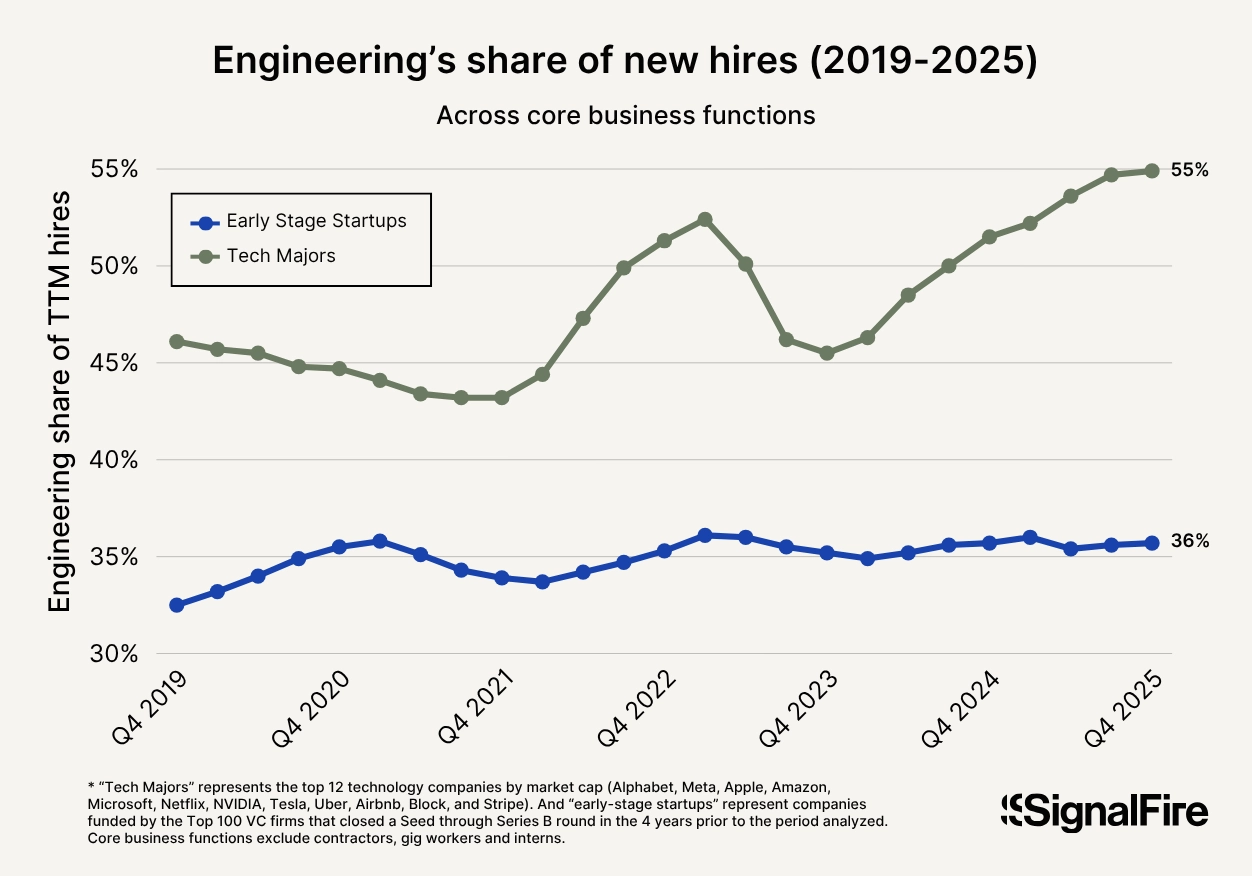
- Inside that shrinking pie, software engineers now account for 55% of all hiring, up from 46% in 2019.
- New grad/entry-level hiring has collapsed further: down roughly 65% at the Tech Majors* and down ~76% at early stage startups* compared to 2019.
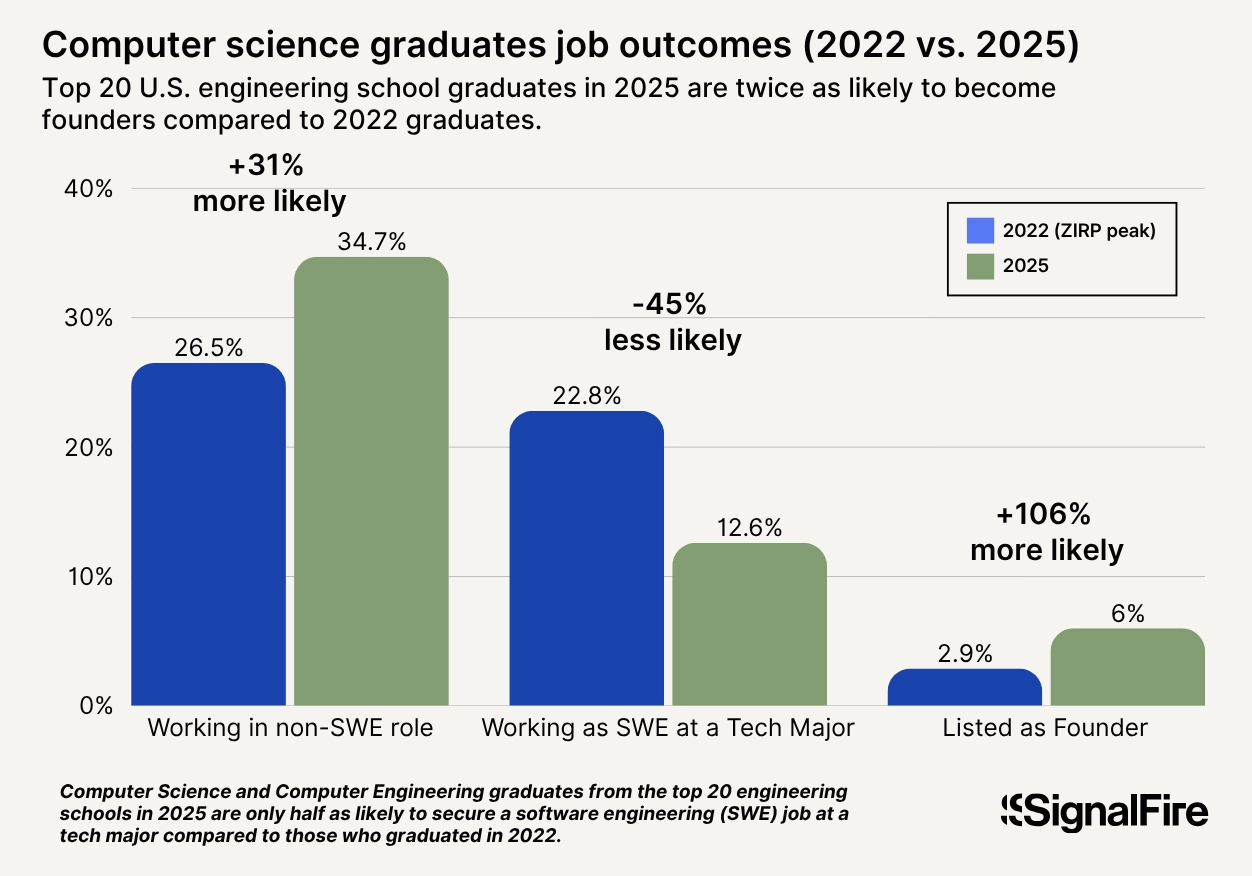
- Top computer science grads in 2025 are twice as likely to call themselves a founder compared to the 2022 class, and 45% less likely to land a job at a Tech Major*.
- Org charts are flattening across the board. Each engineering manager at a Tech Major* now manages ~12 engineers (up from 10), and at startups, it’s ~15 engineers.
- This flattening has paved the way for a new kind of role, the Super IC, an individual contributor operating at a scope historically reserved for managers and directors.
- Startups are hiring at a healthier clip into structurally smaller orgs.
Here’s what the data shows, and what it means if you’re building, hiring, or graduating.
1. From boom and bust to a resized company structure
The narrative of a cyclical tech recovery is dead. What we are witnessing is not a temporary layoff cycle that will reverse when macroeconomic winds shift, but a long-term recalibration of team sizes. After the ZIRP-fueled 2022 hiring peak and the subsequent 2023 crash, aggregate tech hiring has plateaued, with trailing-year hiring among major tech companies running at 25% below the 2019 level. This is the lowest level since 2023.
Recent layoffs at major companies like Cisco, Block, Meta, Atlassian, Cloudflare, and LinkedIn highlight this pattern. Cisco, for example, cut roughly 4,000 jobs despite pulling in record quarterly revenue. These corporate actions look less like standard cost-cutting measures and more like aggressive capital reallocations. Many of these orgs are redirecting those budgets directly into AI infrastructure, cybersecurity, and high-leverage technical talent.
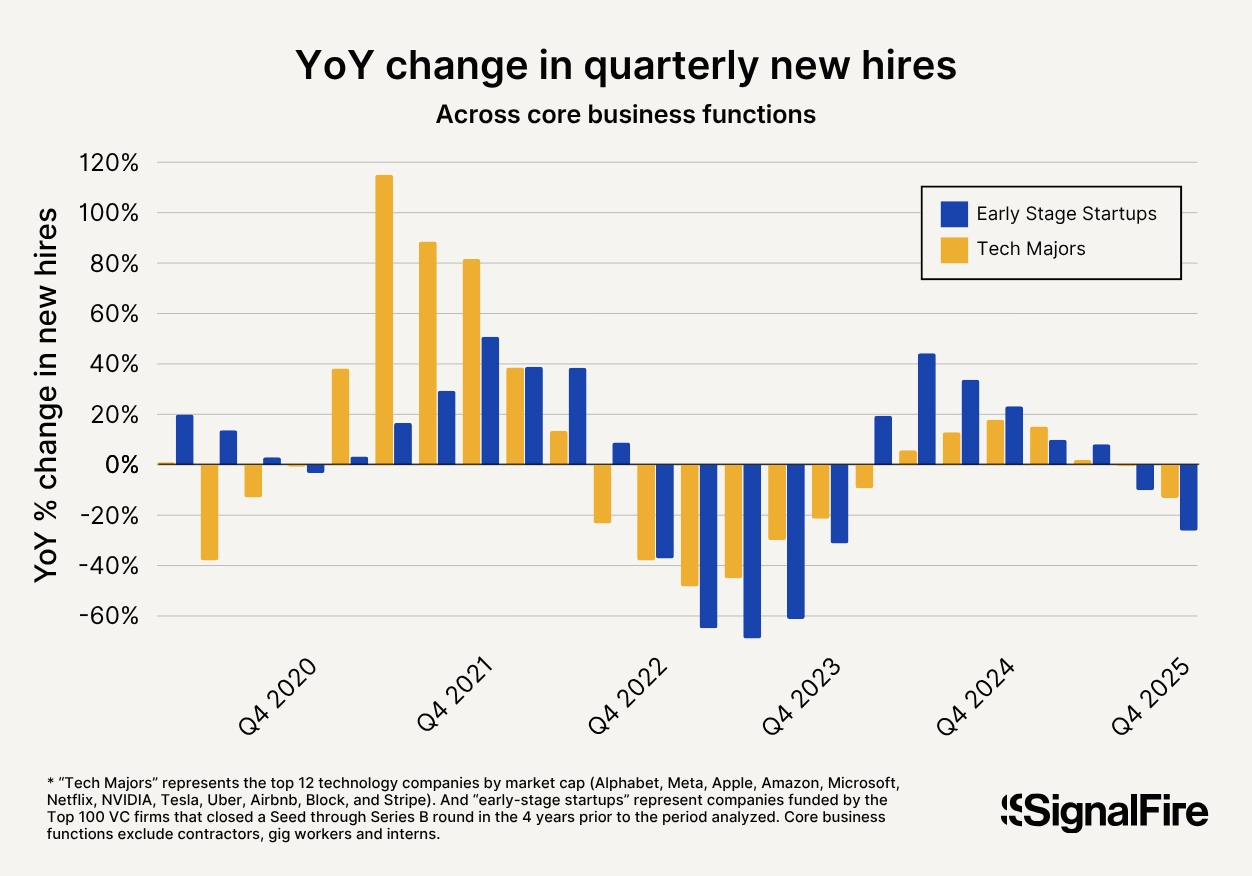
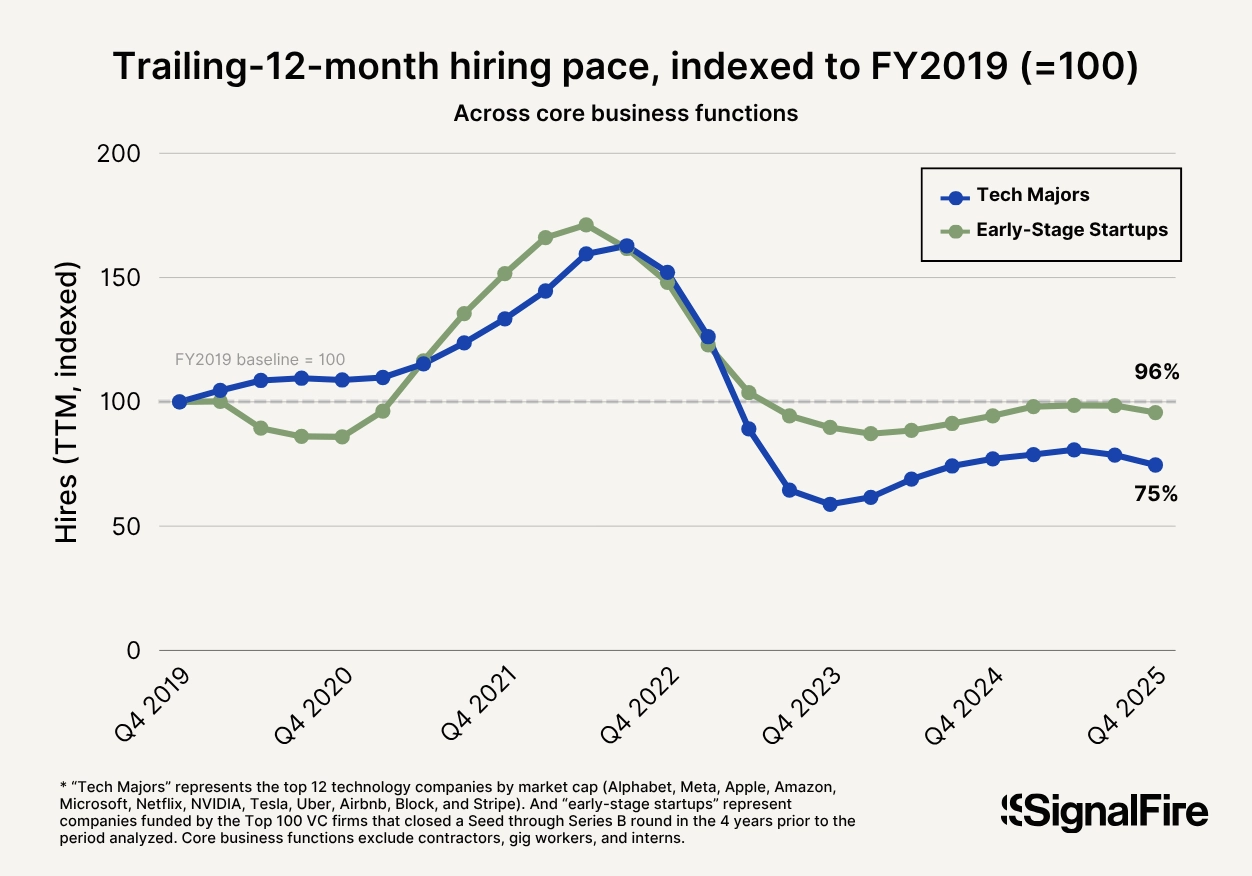
While the boom and bust hit big tech and startups equally, their slow recoveries have fundamentally diverged.
- During the 2022 hiring spike, total hiring at Tech Majors peaked at 63% higher than 2019 levels, while early-stage startup hiring was 71% higher.
- In early 2023, hiring across both groups crashed, and the industry began a slow recovery in late 2023.
- In early 2025, total hiring at Tech Majors plateaued and started to fall again by the end of the year. It is now 25% lower than the 2019 baseline.
- In comparison, at early-stage startups (which historically rebound the fastest), hiring is only 4% below the 2019 baseline.
One caveat worth stating: More hiring at startups doesn’t mean bigger startups. While aggregate hiring in the early-stage startup ecosystem sits close to pre-pandemic levels, the underlying data reveals that startup team sizes are shrinking. Startups are shipping more products with fewer full-time employees. (Carta’s data shows team sizes shrinking even as hiring rebounds, especially at Seed and Series B stages.)
Startups are hiring at a healthier clip into structurally smaller orgs.
2. The AI code apocalypse impacted designers and marketers, not engineers
Contrary to the dominant narrative that software engineers stand to lose the most from AI automation, our data shows that engineers are among the least affected functions in 2025. Instead of shrinking the technical workforce, AI tools are actually making engineers more valuable.
At the Tech Majors, overall hiring is down 25% from 2019, but engineering hiring is down by only 11%. Within a smaller overall hiring pie, software engineers now represent a majority (55%) of all hiring at the Tech Majors (Alphabet, Meta, Apple, Amazon, Microsoft, Netflix, NVIDIA, Tesla, Uber, Airbnb, Block, and Stripe), up from 46% in 2019.
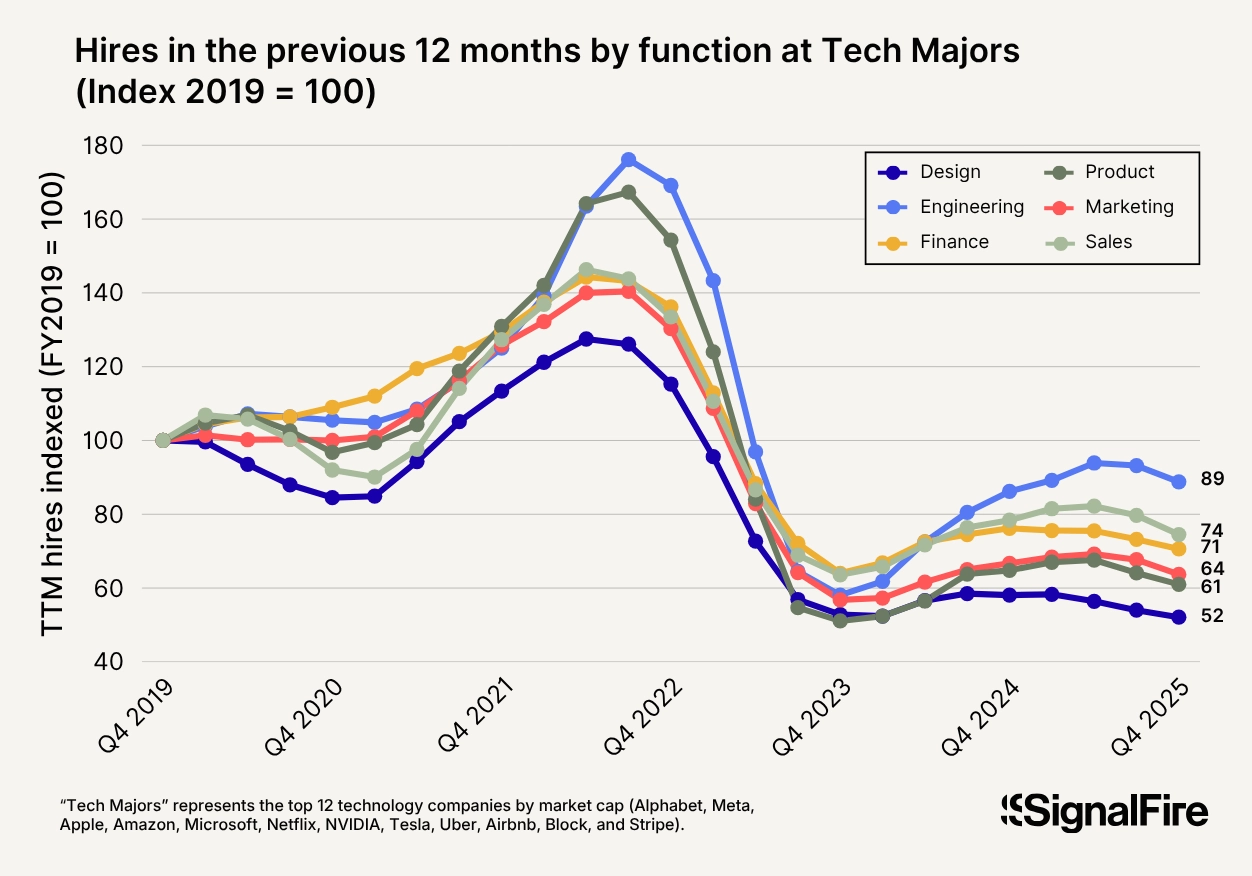
Engineers are being hired faster and turning over more slowly than any other corporate function, posting a low ~9% attritionrate, compared to ~13% for sales and design. Even during recent layoffs at notable tech companies like Block, engineers accounted for less than 30% of those let go, even though they made up a larger share of the workforce.
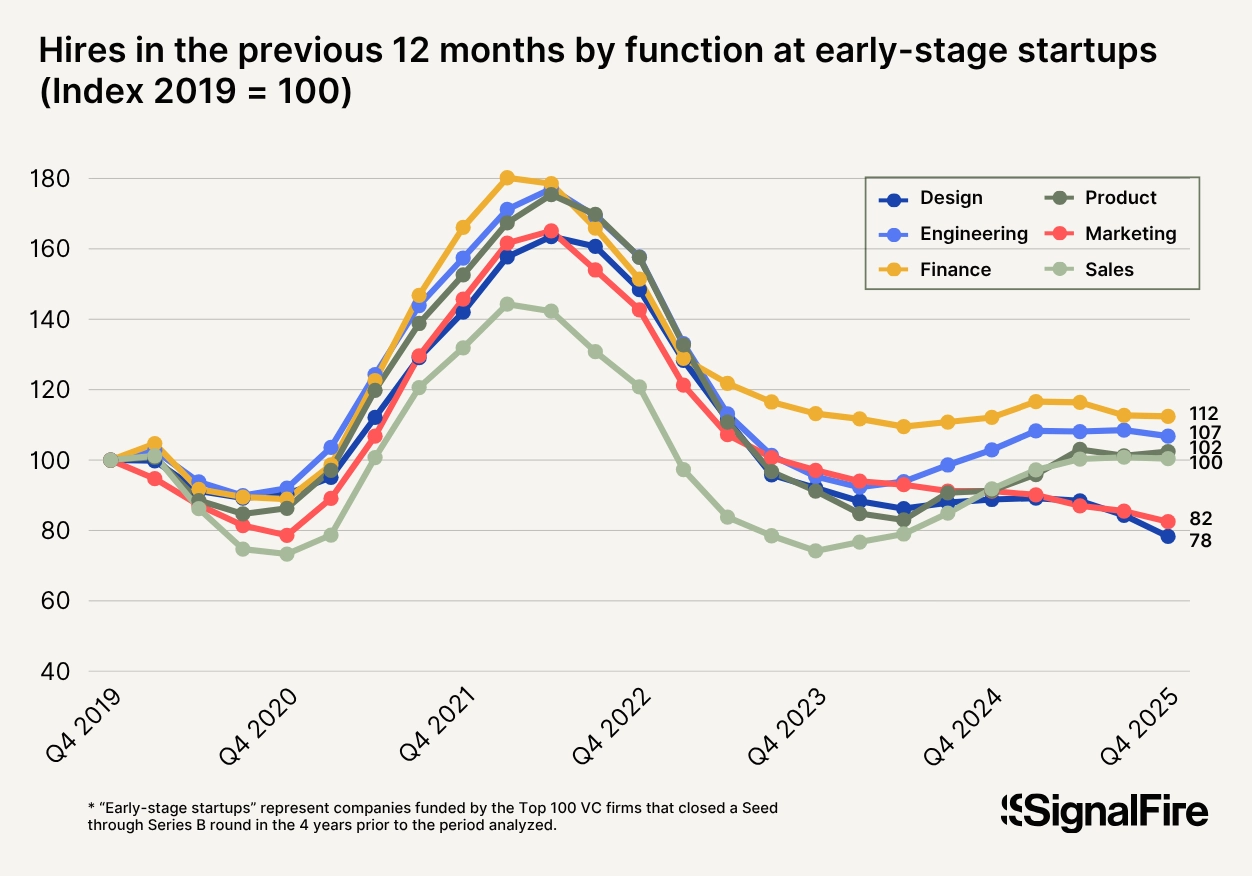
At early-stage startups, the gap is even starker: engineering hiring is actually up 7%, while design is down 22% and marketing is down 18%.
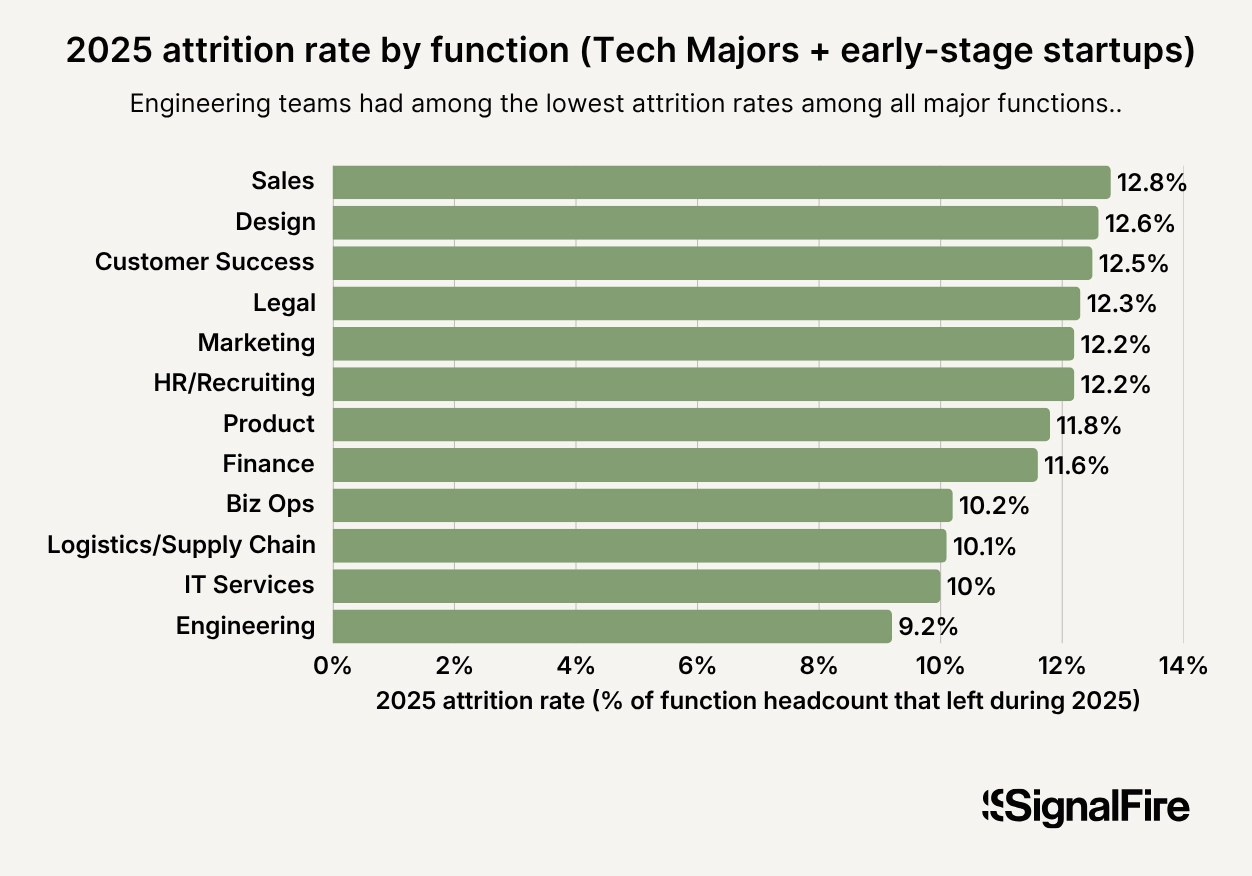
When we look at the impact by role since 2019, the divergence between the builders and the support layers is undeniable:
- Engineering: Down a modest 11% at Tech Majors, but up 7% at startups.
- Design: Down 48% at Tech Majors and down 22% at startups.
- Product Management: Down 39% at Tech Majors but up 2% at startups.
- Marketing: Down 36% at Tech Majors and down 18% at startups.
It’s important to note that engineering’s share of hiring is rising because everything around it is shrinking faster, not because engineering jobs are booming. Engineering is still hiring slightly below its 2019 pace.
Inside engineering, the mix is shifting
Within engineering, there have also been notable shifts in the relative share of different specialists. The core role map is shifting from narrow craft specialization to systemic leverage.
- Since the launch of ChatGPT in 2022, the share of AI/ML Engineers has grown by 39%, and that of Research Engineers by 28%.
- We’re also seeing a notable rise in Sales Engineers (up ~11%) and Forward-Deployed Engineers (+30%), who act as consultants and help customers buy, onboard, and use AI effectively. Cybersecurity roles grew by a modest 3%.
- In contrast, roles that are centered on specific platforms or parts of the stack are in relative decline. For example, the share of front-end engineer roles is down ~25%, the steepest decline among engineering specialties.
As generative AI platforms allow backend generalists to spin up, modify, and personalize user interfaces instantly, pure front-end specialization is being absorbed. The demand has migrated to engineers who can build models, ship infrastructure, and manage complex customer integrations.

3. The flattening of the org chart and the rise of the "Super IC"
Tech organizations continue to shrink, and the modern org chart is flattening across three axes simultaneously. During the hyper-growth era leading up to 2022, tech companies hired massive cohorts of junior talent, creating a heavy management premium. This required a dense scaffolding of Product Managers to break down tasks and Engineering Managers to handle manual code reviews and coordination.
Today, that model has inverted. AI tools dramatically increase the productivity and execution speed of senior engineers. Junior engineers can slow a team down because the operational bottleneck has moved from writing code to reviewing it.
Consequently, organizations are permanently dismantling their middle layers:
- Wider spans of control: Each engineering manager at a Tech Major now supervises ~12 engineers, a 14% increase from 2019. Early-stage startups have flattened even faster, averaging ~15 engineers per engineering manager (a 34% increase).
- The PM thinning: Product Managers at Tech Majors now support 22% more engineers than they did in 2019.
- Fewer coordination layers: Middle managers have wider scopes, leaving experienced, self-directed engineers with minimal corporate friction.
- Beyond engineering: The senior management layer has thinned in nearly every core function, not just engineering.
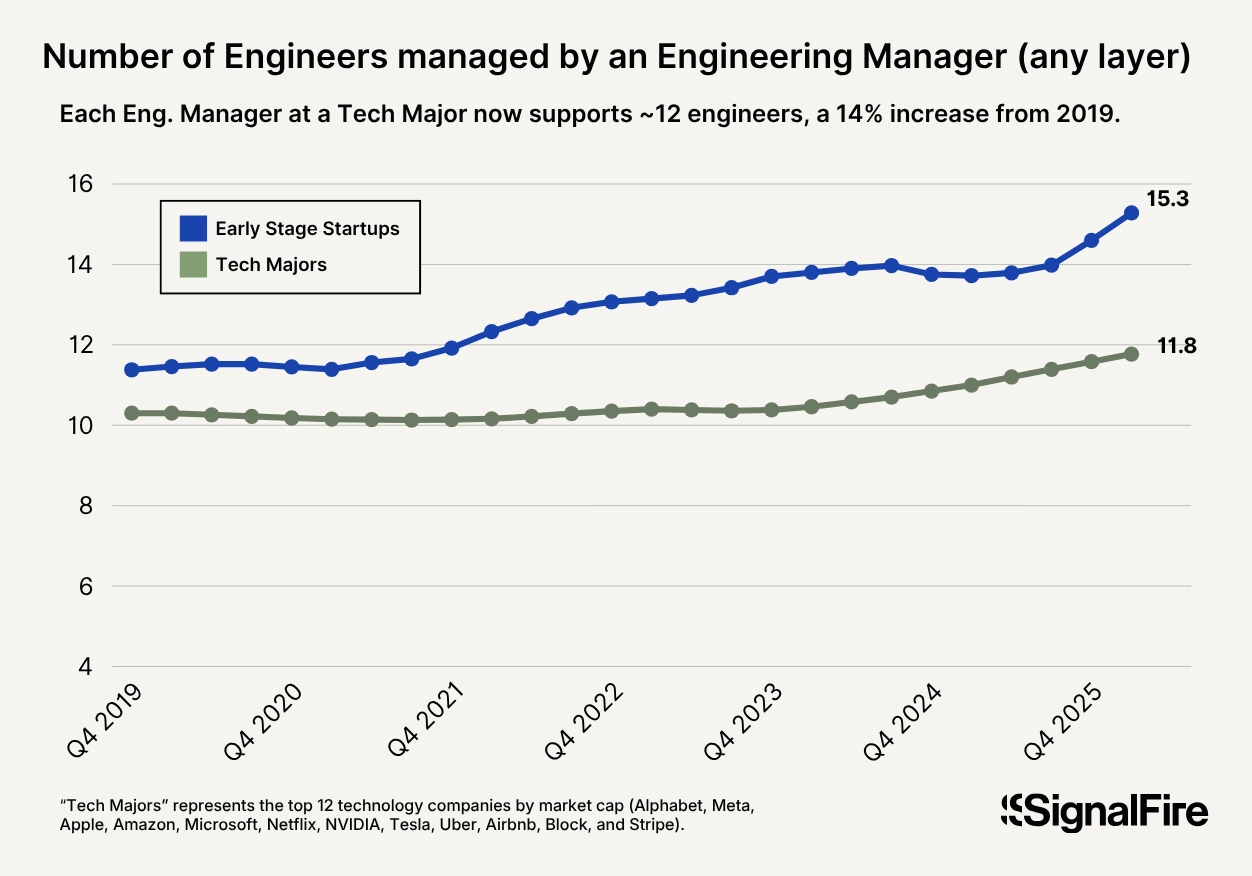
You don’t need a manager for every six or seven self-directed engineers. Startups are leading the charge here: as spans widen and support roles disappear, the manager's job is shifting from coordination to calibration, defining what great looks like, and raising the bar to get there.
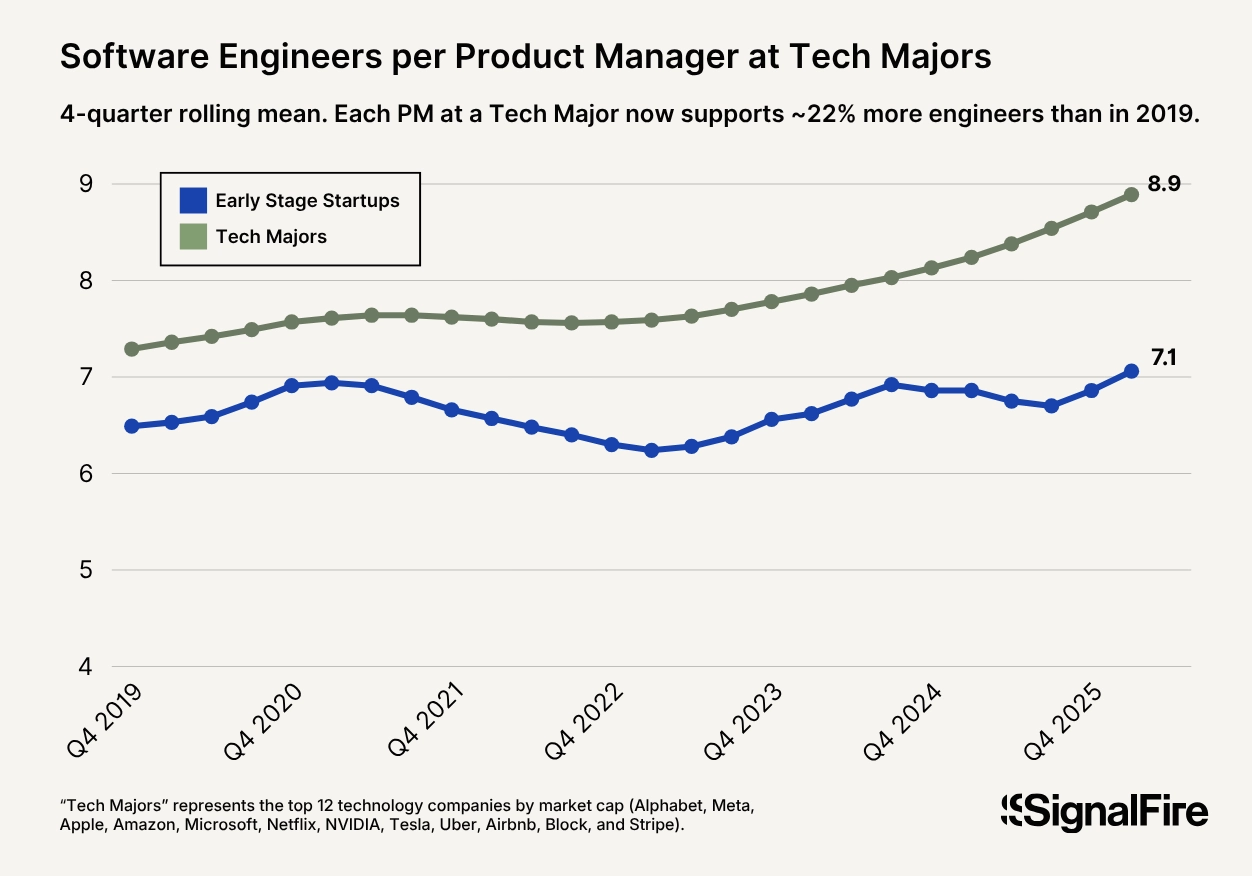
How the top ICs eclipsed the management premium
This org flattening has paved the way for a new kind of role, the Super IC, an individual contributor operating at a scope historically reserved for managers and directors. As AI collapses the coordination and work that previously required five or six specialists, a single capable engineer can now own an end-to-end product surface alone.
The numbers prove it. Senior IC and staff roles are growing as a share of hiring, while engineering manager roles are flat or declining. Compensation structures are also following this exact curve: top-of-band staff and principal packages at the Tech Majors now rival or beat director pay, reversing the management premium that defined tech careers for two decades.
For ambitious engineers, this is the most consequential career shift of the cycle. The path to a wider scope, more comp, and stronger influence no longer runs through management. It runs through technical leverage, and AI is the lever.
4. The broken career ladder and the founder pivot
The most severe human cost of this structural rebalance in tech is the continued contraction of entry-level hiring. Companies of all sizes are prioritizing experienced ICs rather than investing in training new grads and early-career hires.
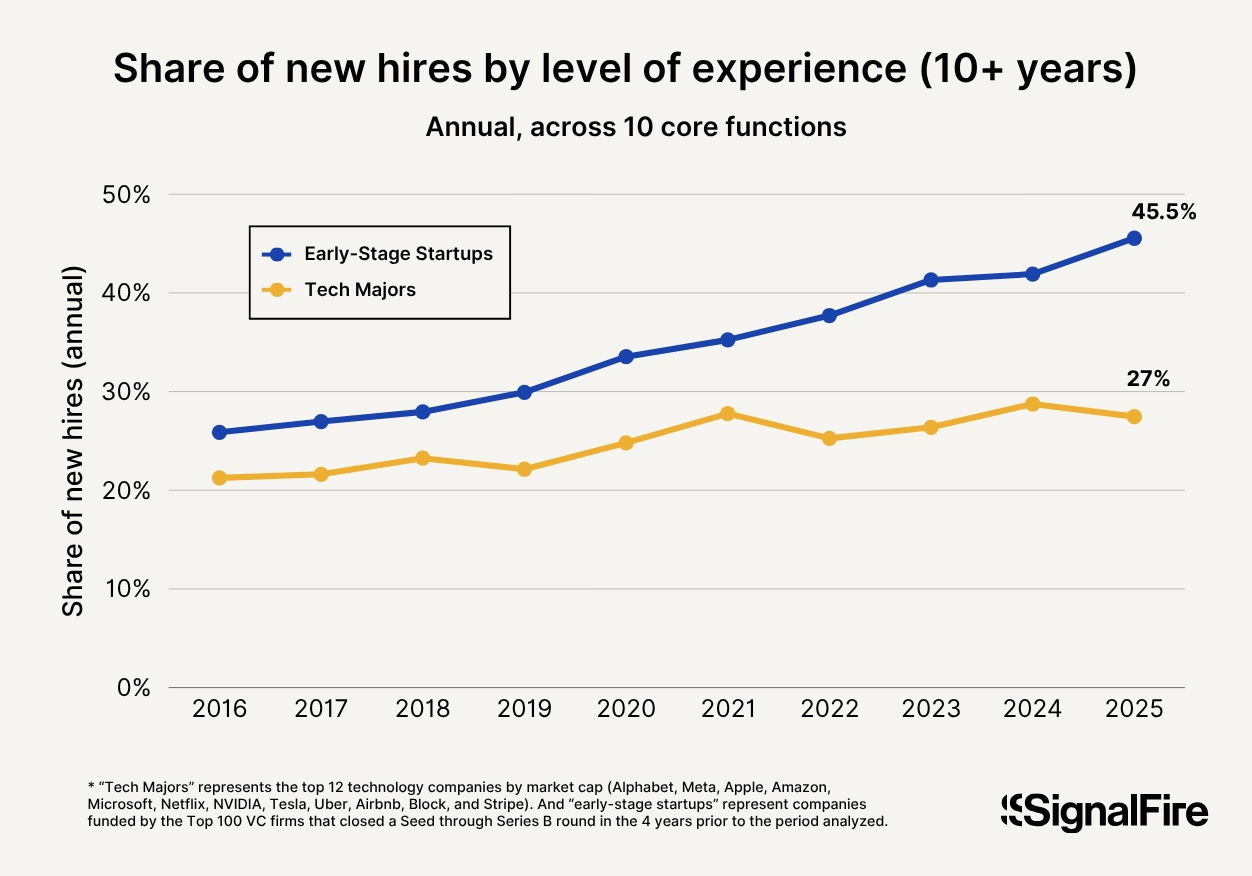
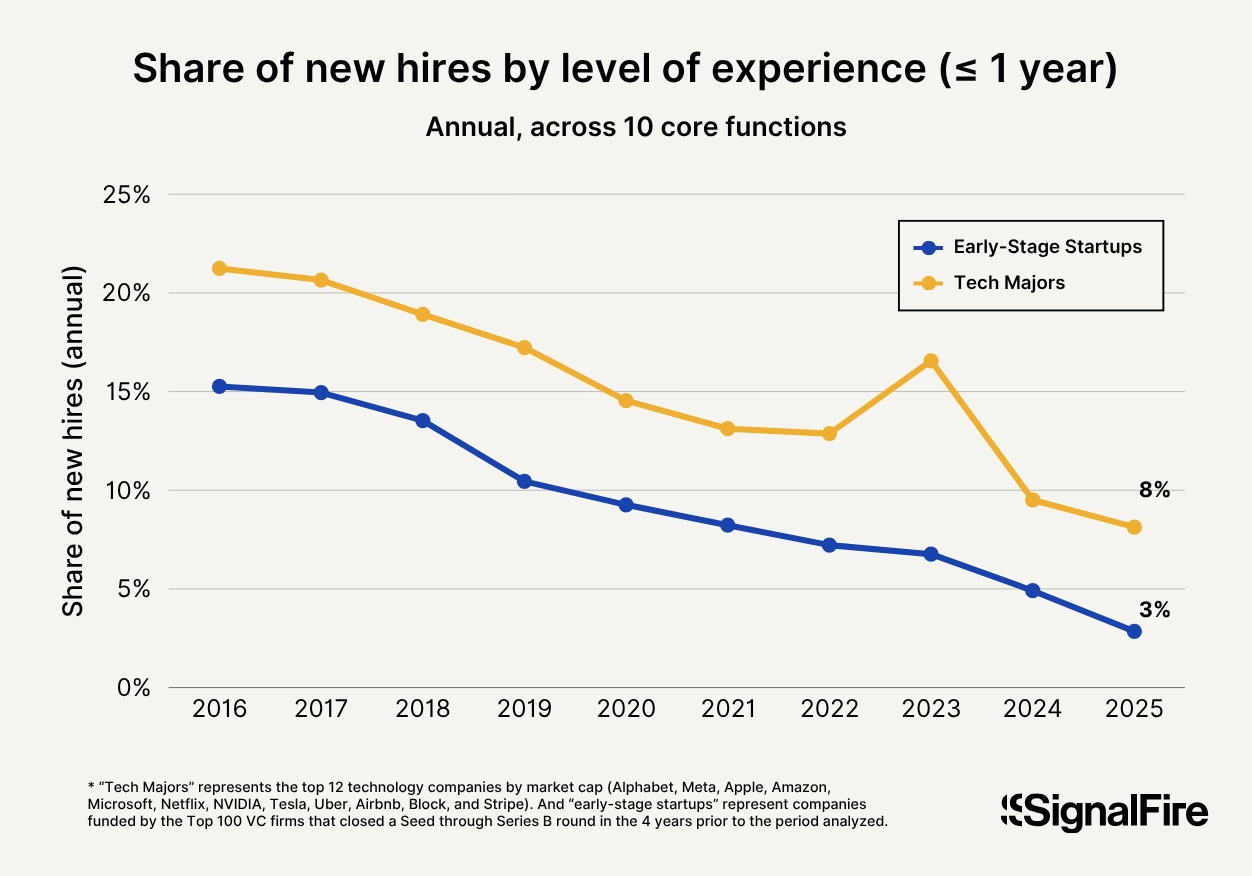
Overall tech headcount growth slowed dramatically after 2023, and the industry has built a large pool of experienced workers. In a landscape with fewer job openings at tech companies, the ratio of experienced candidates relative to the number of job openings is higher than it’s ever been in the last decade.


Why starting a company is the new entry-level job
Many computer science graduates from the top schools are refusing to wait out this hiring freeze. Instead, they are entirely routing around the traditional corporate ladder.
Graduates from the top 20 U.S. computer science programs in 2025 are 45% less likely to take an engineering role at a Tech Major compared to just a few years ago. Software engineering graduates used to spend their first 12 to 18 months writing boilerplate code, running unit tests, and performing routine debugging while learning production systems under a mentor. Those are exactly the types of tasks that the Tech Majors have automated with AI. Facing record competition for a shrinking number of junior seats, the most AI-fluent graduates are using that fluency to build their own startups instead of waiting out a frozen job market.
New graduates are now twice as likely to be a "founder" than they were at the 2022 market peak.
AI has compressed the classic tech career path:
From: (Learn to code) –> (Join big tech company) –> (Build confidence) –> (Understand customers) –> (Become a founder)
To a direct execution loop: (Build a working prototype) –> (Acquire active users) –> (Become a startup founder)
By cutting down on entry-level hiring to save short-term costs, Big Tech may unintentionally be incubating its next generation of competitors outside its own walls.
5. The Frontier AI labs are growing into incumbents
The idea that Frontier AI labs (OpenAI, Anthropic, Google DeepMind, xAI, Mistral, and Cohere) are a radically different kind of org from big tech is fading. As they scale, AI Lab org charts are converging with those of big tech. This convergence is driven by their transition from academic research outfits to highly scrutinized, capital-intensive commercial enterprises.
The first wave of generative AI was characterized by engineering-heavy research cohorts. However, the realities of global commercialization have forced an operational evolution:
- Back-office intensity: AI labs actually maintain higher ratios of HR/Recruiting (9.2%), Finance (5.1%), and Legal (2.3%) staffing than incumbent tech giants
- Operational friction: Managing multi-billion-dollar compute infrastructure, structured token and equity compensation mechanics, aggressive cross-company talent poaching, complex data copyright lawsuits, and impending regulatory compliance requires significant human management.
In sales, marketing, and design, especially, the labs look a lot like the Tech Majors.
As their core models morph into commercial enterprise software, labs like OpenAI and Anthropic are building out traditional corporate sales, marketing, and support engines. Aside from their heavy emphasis on recruiting and finance roles, the broader functional distribution at Frontier Labs mirrors that of the incumbents they are attempting to replace.

As labs like OpenAI and Anthropic race to secure multi-billion-dollar compute infrastructure and navigate aggressive corporate poaching, they have been forced to build out extensive recruiting and finance operations simply to manage the operational complexity. Furthermore, amid mounting legal scrutiny of data copyright and the impending regulatory compliance frameworks, the non-engineering operational headcount at these labs has spiked to mitigate risk.
Ultimately, the data indicates that AI labs are shedding their "radical startup" exemptions and adopting the mature corporate architecture necessary to sustain their position as the new pillars of the technology sector.
The compression of the modern engineering core
The AI coding apocalypse never came for engineers, and the 2026 tech company is compressing into a senior-led engineering core.
The critical systemic risk arises when an entire industry stops investing in early-career talent. By eliminating its new grad pipeline to optimize current balance sheets, the tech industry could face a severe leadership vacuum over the next decade.
The other reality embedded in the data is a fundamental cultural inversion: the tech sector, which built its global dominance on hiring smart 22-year-olds and betting on their trajectory, has retired that playbook. Whatever comes next will be built largely by the generation that managed to cross the threshold before the door slammed shut.
Strategic recommendations
For startup founders & CEOs
- Hire Solutions Engineers early: If your product requires complex enterprise workflow change, implementation, or deep data security integration, bring in solutions engineers early that can be forward-deployed to build market trust and accelerate conversion.
- Reframe junior talent as agent operators: Stop viewing early-career hires as individuals who need to be trained on simple code tickets. Hire high-agency, AI-native new grads who can manage autonomous workflows, run rapid prototyping experiments, and audit automated code outputs.
- Consolidate Front End and Product Design: Merge front-end implementation, design, and product prototyping into cross-functional "product builder" roles.
- Reinventing the middle layer: Do not copy the legacy tech org chart. Explicitly measure your engineers per engineering manager, engineers per product manager, and builders per non-builder. Use AI leverage per employee as your primary planning metric rather than raw headcount growth.
For enterprise & big tech leaders
- Address the long-term succession vacuum: Eliminating your entry-level engineering pipeline boosts short-term operating margins but creates a structural leadership and talent crisis five to ten years down the road.
- Deploy AI apprenticeship programs: Replace legacy new grad programs with models where junior talent manages, tests, and improves AI-assisted workflows, pairing them with senior ICs on judgment-heavy review loops rather than routine execution.
- Dismantle the coordination scaffolding: Stop asking, "How many people can AI replace?" and start asking, "Which management and alignment layers did we only build because information flow used to be slow, manual, and fragmented?"
- Refocus PMs on product taste: Push Product Managers away from basic JIRA ticket management and completely toward analyzing customer signals, identifying product positioning, and building rigorous evaluation design.
For new grads & technical job seekers
- Bypass the permission economy: The old corporate onboarding model is offline. The most reliable path to a career in tech is no longer getting hired and waiting to be trained—it is demonstrating proof of work before anyone gives you permission.
- Optimize for tangible output: Build a verifiable portfolio of shipped applications, active open-source contributions, custom agent workflows, and documented customer discovery. Treat independent execution as your true credential.
- Target leverage over corporate prestige: The highly structured corporate internships with months of gentle onboarding are a relic of the hyper-growth era. In a flattened, senior-led engineering core, the most competitive candidates approach internships as force multipliers. When targeting internships, optimize for teams actively implementing agentic AI, custom LLM fine-tuning, or data pipeline scaling.
_____________________________________________________________________
Methodology Note:
This report uses data from our proprietary Beacon AI platform, an intelligence engine that tracks 650+ million individuals and 80+ million organizations. We analyze millions of data points on
hiring trends, geographic movements, and more to spot emerging talent and help our portfolio companies build teams and products faster.
Here's the approach we used to analyze the data for this report:
* “Tech Majors” represents these 12 technology companies: Alphabet, Meta, Apple, Amazon, Microsoft, Netflix, NVIDIA, Tesla, Uber, Airbnb, Block, and Stripe.
* “Early-stage startups” represent companies funded by the Top 100 VC firms that closed a Seed through Series B round in the 4 years prior to the period analyzed.
* For the Frontier AI Labs data analysis, we included these 6 major labs: OpenAI, Anthropic, Google DeepMind, xAI, Mistral, and Cohere. Meta AI wasn’t included, as it’s not listed as a distinct entity from Meta as a whole on LinkedIn.
* “Top computer science graduates” represents graduates from the top 20 engineering programs (undergraduate) in the U.S. according to the U.S. News’ Best Undergraduate Engineering Programs Rankings.

Tawni Cranz
Operating Partner
Tawni L. Nazario-Cranz joined SignalFire in 2017 as a Venture Operating Partner and Strategic Advisor. Tawni is a global business executive with more than two decades of experience working for some of the world’s most innovative companies. As a leading business strategist and culture transformer, she drove Netflix, Bausch & Lomb, FedEx Kinko’s and other top companies to record-breaking success. During Tawni’s decade at Netflix, she built out the company’s operations internationally and drove rapid global growth.

Asher Bantock
Head of Research
Asher is the head of research at SignalFire. He provides insights and analyses that inform SignalFire's investment strategy and enable portfolio company success, and builds tools and systems that guide decision-making across the firm. Before SignalFire, Asher was a Staff Data Scientist at Block's CashApp, where he was responsible for analytics for banking products including credit offerings and direct deposits. Prior to that, he was a Data Scientist at Medium, where he designed experimentation tools and the data infrastructure underlying Medium’s writer partner programs.