There are over 568,000 insurance brokers in America. They collect more than $260 billion in commissions annually and place trillions of dollars in premiums. Almost all of these brokers spend much of their day doing exactly the kind of work that LLMs are great at, like reading PDFs, comparing policies, filling out ACORD forms, and rekeying unstructured data across legacy systems from the 1980s.
Commercial insurance is not a direct-to-consumer market. It’s deeply intermediated and primarily moves through brokers who are the true engine of the industry. They originate the risk, shop it across fragmented markets, negotiate pricing, and manage the customer relationship long after the policy binds. Yet, there is a glaring structural irony: the vital node closest to the customer and the actual revenue motion is operating on the industry's most antiquated legacy software.
Manual workflows and massive inefficiencies in the insurance brokerage space are arguably among the single largest unaddressed vertical AI opportunities today.
From balance sheet to distribution: The next era of Insurtech
For the last two decades, insurtech modernization has mostly focused on carriers because they own the balance sheet, underwrite risk, price policies, collect premiums, and pay claims. Their core workflows, including policy administration, billing, claims, rating, underwriting, and analytics, became the obvious place to build large systems of record. Companies like Guidewire and Duck Creek became category-defining platforms, empowering carriers with tech infrastructure to run their core insurance engines.
Brokerages sat in a different part of the value chain, but while they did not own the balance sheet, they controlled a large share of the commercial motion. Brokers are the connective tissue between policyholders and the market, yet they’ve been patching together legacy software to do their jobs without ever having a platform moment.
Most brokerages still operate inside agency management systems like Applied Epic and AMS360, surrounded by email, PDFs, spreadsheets, ACORD forms, carrier portals, and document repositories. These systems are important because they store client, policy, activity, and accounting data, but they are not execution systems that brokers can use for their daily work, which is where their real pain lives.
A submission becomes a quote, a quote becomes a binder, and a binder then becomes a policy. At every stage, someone has to read documents, compare terms, summarize differences, check for gaps, generate client-ready materials, and make sure the AMS reflects what actually happened. It is repetitive, high-volume, detail-oriented work that carries a real downside when something is missed: an uncovered exposure, a wrong endorsement, or an E&O risk that only shows up after a claim is made.
Until recently, automating an insurance broker’s workflow seemed unsolvable. The data is fragmented, and decisions require subjective human judgment that legacy software couldn’t handle. But foundation models fundamentally change the shape of the problem. For the first time, AI tools can read the messy documents, contextualize the risk, and produce broker-ready work with an audit trail.
Outmarket is rewiring the commercial broker workflow
Last week, we announced our investment in Outmarket AI’s $17M Series A. Here's why we believe insurance brokerage is one of the biggest vertical AI opportunities hiding in plain sight, and why the Outmarket team is the one to win it.
Outmarket is the AI-native intelligence layer for insurance brokerages. The platform delivers value across two core pillars.
- It serves as a system of action, deploying AI workflows to remove the administrative drag that consumes producers and account managers.
- It acts as a predictive intelligence layer, turning the brokerage’s static book of business into real-time data and insights for cross-selling, pipeline forecasting, and net-new production.
Outmarket plugs into the systems brokers already live in (e.g., Applied Epic, AMS360, HawkSoft, and Nexsure), and the document repositories and email threads around them. It then turns the brokerage's structured and unstructured data into an active platform that automates:
- Proposal building: Brokers upload policy documents, and Outmarket turns them into custom-branded, client-ready proposals in minutes.
- Policy checks: Outmarket compares quotes, proposals, or binders to the policy document and AMS data to flag discrepancies and take action (e.g., email the carrier or edit the AMS). BPOs would typically charge $15-$30 per policy for this (and often do it badly). Now, it can be done in seconds with higher accuracy and a full audit trail.
- Coverage gap analysis: Automatic policy checks highlight coverage gaps as soon as a quote or binder is issued, so brokers can flag risks to clients before a claim is denied. This directly reduces the agency's E&O exposure.
- Appetite search: Agents can make natural-language queries against a commercial insurance knowledge graph to match the right risk to the right carriers in real time.
- Loss runs and risk management: Outmarket can order, ingest, and analyze loss run documents across carriers and clients, build a loss explorer view across an insured's full book, and surface concentration risk and AI-generated recommendations to reduce future losses.
A generic horizontal AI copilot cannot work for the distribution layer. Broker workflows are too specialized, and the E&O risk is too high to trust out-of-the-box AI with carrier negotiations, complex policy parsing, and client-facing outputs. Outmarket is differentiated by its deep insurance context, embedded directly into the workflow logic and the UI, and by an uncompromising audit trail.
What truly distinguishes this team, however, is their shipping velocity. Over the last 12 months, Outmarket has evolved from a handful of commercial workflows into a full product line covering commercial, benefits, personal lines, and risk management. They’ve shipped native integrations across every major AMS, a live API gateway, and full SOC 2 Type 2, ISO 27001, and HIPAA compliance at breakneck speed, establishing a formidable technical moat.
Built by founders who spent years solving large-scale data complexity
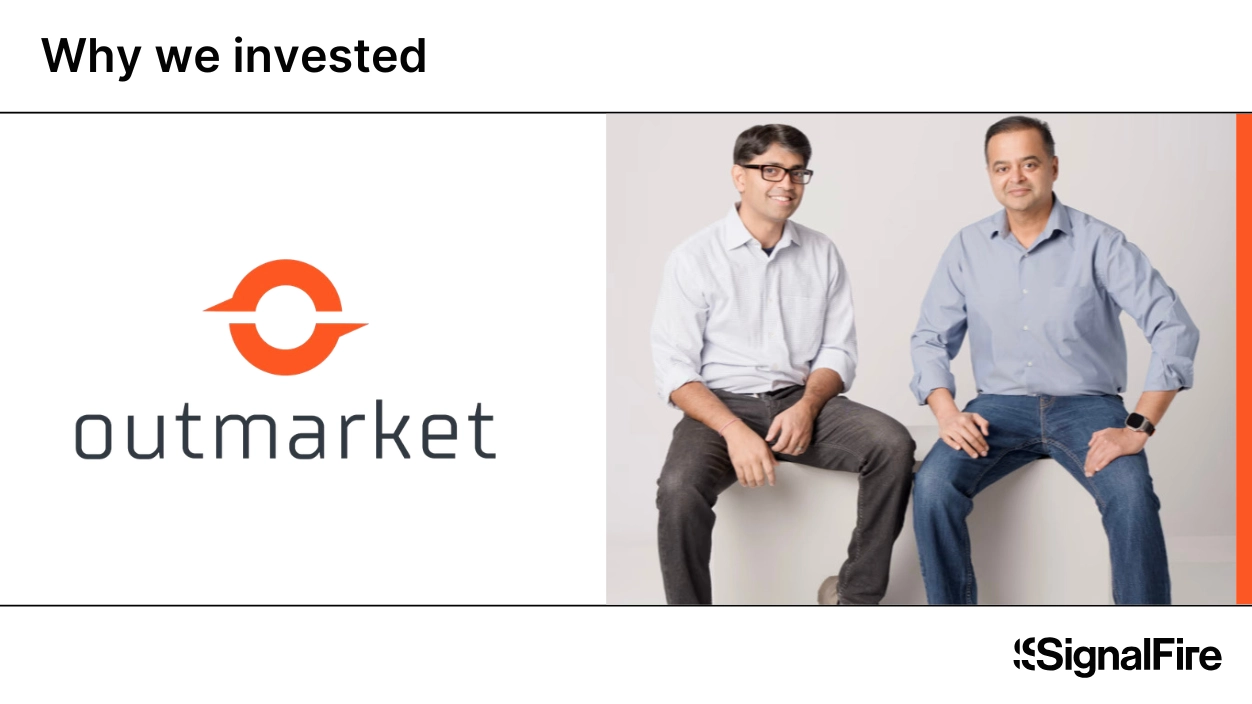
Modernizing insurance brokerage workflows is less about flashy AI and more about taming massive, unstructured data sets, a challenge Outmarket’s co-founders, Vishal Sankhla and Anshu Jain, have spent their careers solving.
The team brings a rare overlap of big tech infrastructure experience and deep insurtech domain knowledge. Vishal led product at Uber and engineering at Meta before diving into the insurance ecosystem as VP of Product at Ethos, one of the largest U.S. life insurance issuers. Anshu brings a deep AI and machine learning pedigree from his early leadership at IBM Watson and from engineering leadership at both Meta and Ethos. Their shared background equips them with the technical DNA they need to untangle the complexities of the broker ecosystem.
While Outmarket’s headline metrics are exceptional—securing 250 top brokerages and landing $1M+ ACV deals within their first year—these are lagging indicators of the company's true moat. SignalFire leaned into this round because of the unprecedented customer loyalty driving those numbers.
In our diligence, we interviewed over a dozen enterprise brokerages, many of whom had rigorously evaluated competitors’ products. Buyers consistently highlighted the structural differentiation of Outmarket's intelligence layer, their language accuracy, and their customer service. It is rare to hear this level of positive feedback relative to incumbent solutions in this industry.
The next category-defining vertical AI platform
Over the next five years, vertical AI will mint a select few category-defining companies. We’ve seen the blueprint: Harvey proved it for elite legal workflows, Abridge for healthcare, and EvenUp for personal injury law. This same shift is coming to every document-heavy, highly regulated industry, but among these, insurance distribution stands apart, boasting the largest TAM, the highest domain-specificity barrier, and the most fragmented buyer base.
We believe Outmarket will be the company to define this category and finally equip brokers with the modern intelligence layer they deserve. We couldn't be prouder to partner with Anshu, Vishal, and the entire Outmarket team as they build the system of intelligence for the world’s risk managers.
Are you building in vertical AI for insurance? We’d love to connect. Reach out to us at t@signalfire.com or aayush@signalfire.com.

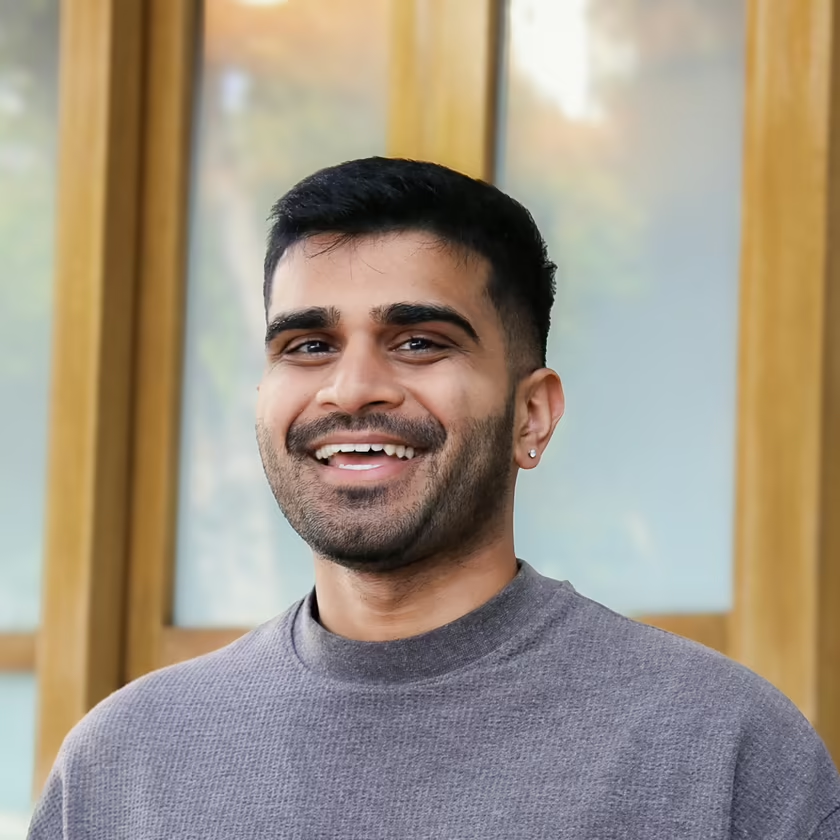
Tony Pezzullo
Partner
Tony joined SignalFire to help form the initial NYC presence in 2021, and leads Series A and B stage investments focused on enterprise and vertical AI, healthtech, cybersecurity, and other areas of innovation.
Aayush Sharma
Senior Associate