
The B2B buyer journey has changed in ways most marketing teams haven't fully absorbed. For the past decade, buyers browsed vendor websites, left behavioral signals, clicked through ads, and converted through a funnel that teams could measure and optimize. Today, that predictability no longer works. A prospect now queries an LLM, reads a synthesized answer, and moves on without triggering a single pixel and email agents filter cold outreach before a human ever sees it. The behavioral trail that made digital advertising work is being dismantled by the same technology that's supposed to make marketing easier.
What's left is a narrower, but more valuable signal: buyers who are actively researching, in-market, and evaluating. Being able to reach those specific individuals has become one of the few levers in B2B marketing that still works consistently. The problem is that doing it well, for hundreds or thousands of individual buyer journeys simultaneously, required infrastructure that almost no marketing team could build or maintain.
That's the problem Vector solves, and why we're leading their $10M Series A alongside HubSpot Ventures.
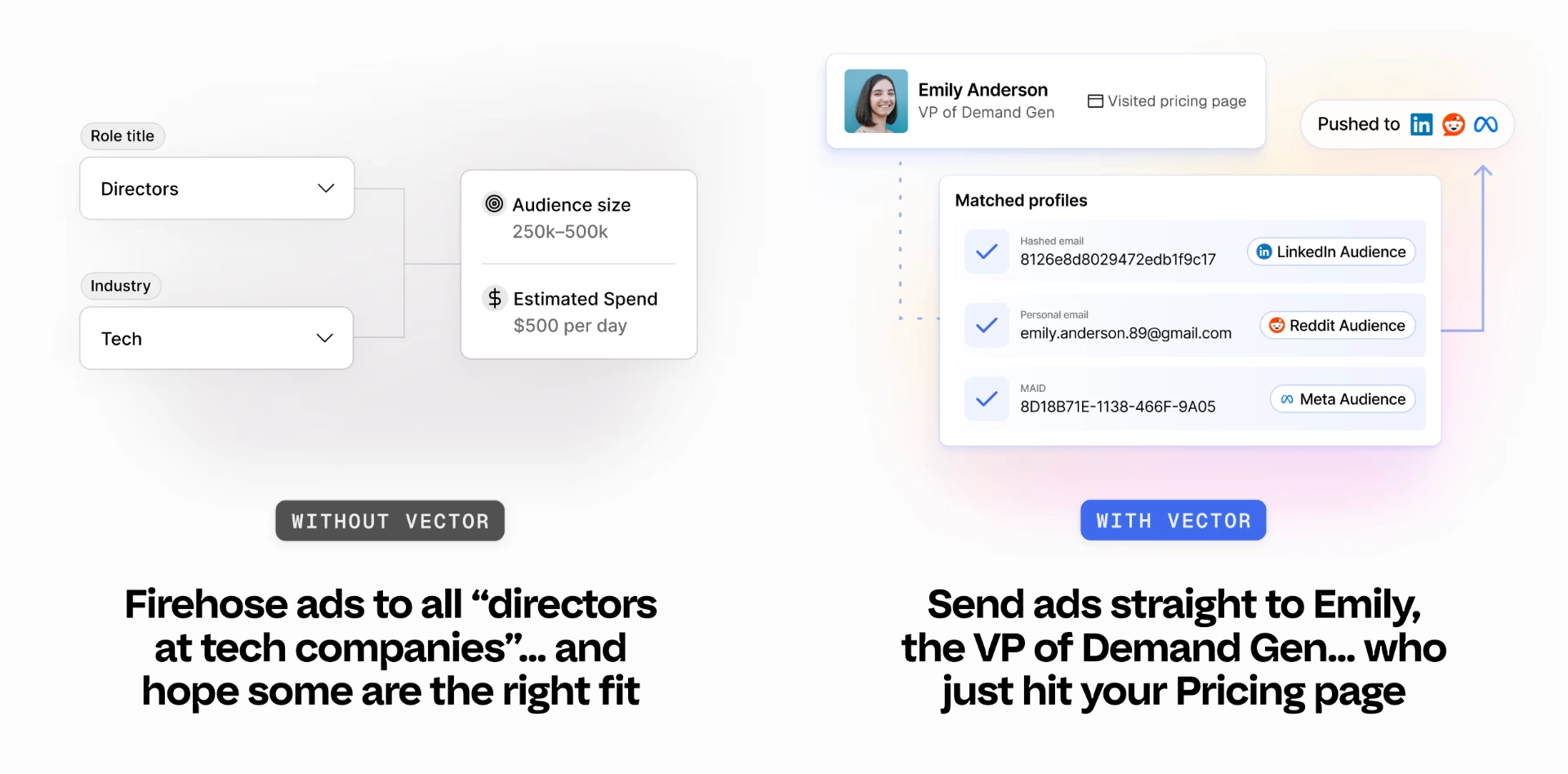
Vector enables B2B marketers to build ad audiences of specific, named buyers based on real intent signals.
From targeting companies to influencing individual buyers
Most B2B ad targeting operates at the account level. You identify businesses that match your ICP, target an IP range, and hope the right person inside the company eventually sees the ad.
Vector operates at a different level. Their platform tracks real buying signals, such as who visited your site, who engaged with a competitor's ad, and who is actively researching your category. It then builds audiences of specific named contacts rather than company domains and orchestrates a personalized ad journey for each contact across LinkedIn, Google, Meta, Reddit, and programmatic channels.
The best B2B sales teams know that sales cycles aren't won by reaching a company but by reaching the right person in that company at the right moment with a message customized to their stage in the decision process. While account-level targeting is a proxy for that, contact-level targeting is the real deal.
The Vector advantage: real-time bidding across the entire funnel
Most platforms stop at audience building. They help you identify the right contacts and then hand the list off to LinkedIn or Google to optimize from there. The problem is that every ad platform optimizes within its own walls: LinkedIn only sees LinkedIn user behavior, and the same goes for Google. Neither platform has any visibility into what's happening across the rest of the stack.
Vector uses cross-channel intent data (like site behavior, CRM signals, and off-site research activity) to fine-tune bids and allocate spend in real time across all channels simultaneously. A buyer with high intent across multiple surfaces is prioritized everywhere, at once, so wasted impressions on low-fit contacts are automatically eliminated. There's no need for manual tuning on each platform, or for an agency to manage the optimization piecemeal.
For their customers, Vector has transitioned from a tactical tool to core infrastructure. By routing all their paid channels exclusively through Vector audiences, they’ve moved past the 'point solution' phase into an operational dependency that effectively replaces their legacy stack.
The platform opportunity emerging in marketing AI
Vector has grown more than 10x over the past year. Their platform sits in the critical path for how their customers execute paid media, and they’ve seen strong expansion driven by more audiences, channels, and broader bid agent deployment.
When HubSpot launched in 2006, the market had no shortage of point solutions for email, CRM, and landing pages. What it lacked was a connected system that treated all of those functions as parts of a single revenue workflow. HubSpot became the operating system for inbound marketing because it owned the data, surfaced the intelligence, and gave marketers a single place to orchestrate everything.
B2B advertising has never had a similar operating system. Demand gen teams still navigate a deeply fragmented stack of LinkedIn Ads, Google Ads, demand-side platforms, attribution vendors, audience management tools, and CRM integrations that rarely communicate well with each other. Building a paid campaign that follows a single buyer across channels, adapts based on their behavior, and ties outcomes back to revenue requires a substantial operations team or custom engineering work that most companies simply cannot afford or staff.
By collapsing these silos into a single, automated workflow, Vector is effectively doing for B2B advertising what HubSpot did for inbound marketing. Having HubSpot Ventures co-lead this round serves as a powerful market validation, confirming that the demand for a unified, agentic GTM stack is no longer a niche bet, but a structural necessity.
Why Vector fits the SignalFire thesis
At SignalFire, we use Beacon, our proprietary AI platform, to track the world's most promising companies and founders. Vector surfaced at an intersection we pay close attention to: a large, structurally fragmented market where AI creates genuine architectural leverage, and a team that's building with a rare combination of precision and velocity.
We get excited when AI re-architects how work gets done rather than just compressing the time it takes to do the same work. Most ad tech operates by simply adding capabilities to existing infrastructure. Vector is rethinking the fundamental unit of targeting from accounts to individual contacts, the unit of execution from manually managed campaigns to automated buyer journeys, and the unit of measurement from last-click attribution to pipeline impact. Those are architectural decisions, and they compound over time in ways that point solutions cannot replicate.
The market opportunity behind this is substantial. Hundreds of thousands of B2B marketing teams run paid advertising today with no reliable way to target specific buyers, automate multi-channel sequences, or attribute pipeline contribution with any confidence. The tooling most of them use was built for a version of the buyer's journey that no longer exists, and the teams feeling that gap most acutely are exactly the ones Vector is built for.
We also care deeply about founder-market fit, and the founders, Nick Masters and Joshua Perk, spent years in demand gen and GTM functions at companies like Drift, building solutions to problems they lived firsthand. This deep expertise shows up in the specificity of the targeting logic, the depth of the attribution model, and the rate at which they've shipped new capabilities since launch.
Building the system of intelligence for B2B growth
With this Series A, Vector is building the complete AI layer that orchestrates each individual buyer's ad journey, optimizes across channels in real time, and connects ad activity to tangible revenue outcomes.
Their long-term vision is to become the system of intelligence for how B2B companies go to market through paid channels, just as HubSpot became the system of record for inbound marketing and sales.
If you're a B2B marketer running paid ads without a clear read on pipeline contribution, we'd love to connect you with the Vector team. Reach out to Varun at varun@signalfire.com.
SignalFire is the first venture capital firm built like a technology company. We help founders navigate the hardest parts of scaling, from recruiting via our Beacon talent engine to GTM strategy via our network of seasoned operators.

Varun Ramakrishnan
Principal
Varun is a Principal who joined SignalFire in 2024 focused on venture and growth-stage software investments. Prior to joining SignalFire, Varun spent ~3 years at General Atlantic in New York & San Francisco where he invested in growth-stage and pre-IPO enterprise software and companies globally.