Forget the frustrating, scripted chatbots of yesterday. The next generation of AI in customer service has arrived, in the form of the Autonomous AI Agent.
Fueled by advanced Large Language Models (LLMs), these systems don't just chat—they are engineered to autonomously design workflows and execute complex actions via integrated internal tools (APIs). Their mandate is simple: meet the customer's goal from start to finish. This shift is driving both superior Customer Experience (CX) and unprecedented operational efficiency. Whether it manifests as a sophisticated chatbot or a seamless voice assistant, the autonomous agent is fundamentally redefining the support experience.
To help you navigate this revolution, we've gathered best practices from industry-leading experts, including:
- Sarung Tripathi, VP of Customer Experience at Together AI: With years of experience implementing support systems across top-tier companies, Sarung shares the strategies that helped one client achieve an astonishing 96% automation rate for their support tickets.
- Aaron Lee, CEO of Smith.ai: As the leader of one of the industry's premier voice-based customer support agent services, Aaron distills the key learnings and success factors observed across their 5,000+ customer base.
Here are the four key best practices to make an AI support bot successful:
The foundational layer (knowledge and RAG mastery)
The success in resolving 50%- 60% of documentation-supported tickets confirms that the knowledge base is the foundation of AI support. To push this rate higher, the enterprise knowledge architecture must be purpose-built for AI using RAG applications.
- To maximize retrieval precision, monolithic documents must be divided into smaller, self-contained segments with explicit titles, improving indexing and LLM accuracy. Documents must prioritize machine readability, utilizing proper headings and sequential numbering.
- Continuous updates - Continuously updating information - creating a weekly check-in to update the database with the latest information
- Figuring out how to handle conflicting information - if there is a conflict where multiple sources say different things - prompt the agent to escalate to a human versus making up the answer
- Creating a log of what questions did not have an answer from sources provided, and creating content to address these gaps
Measuring success and benchmarking performance
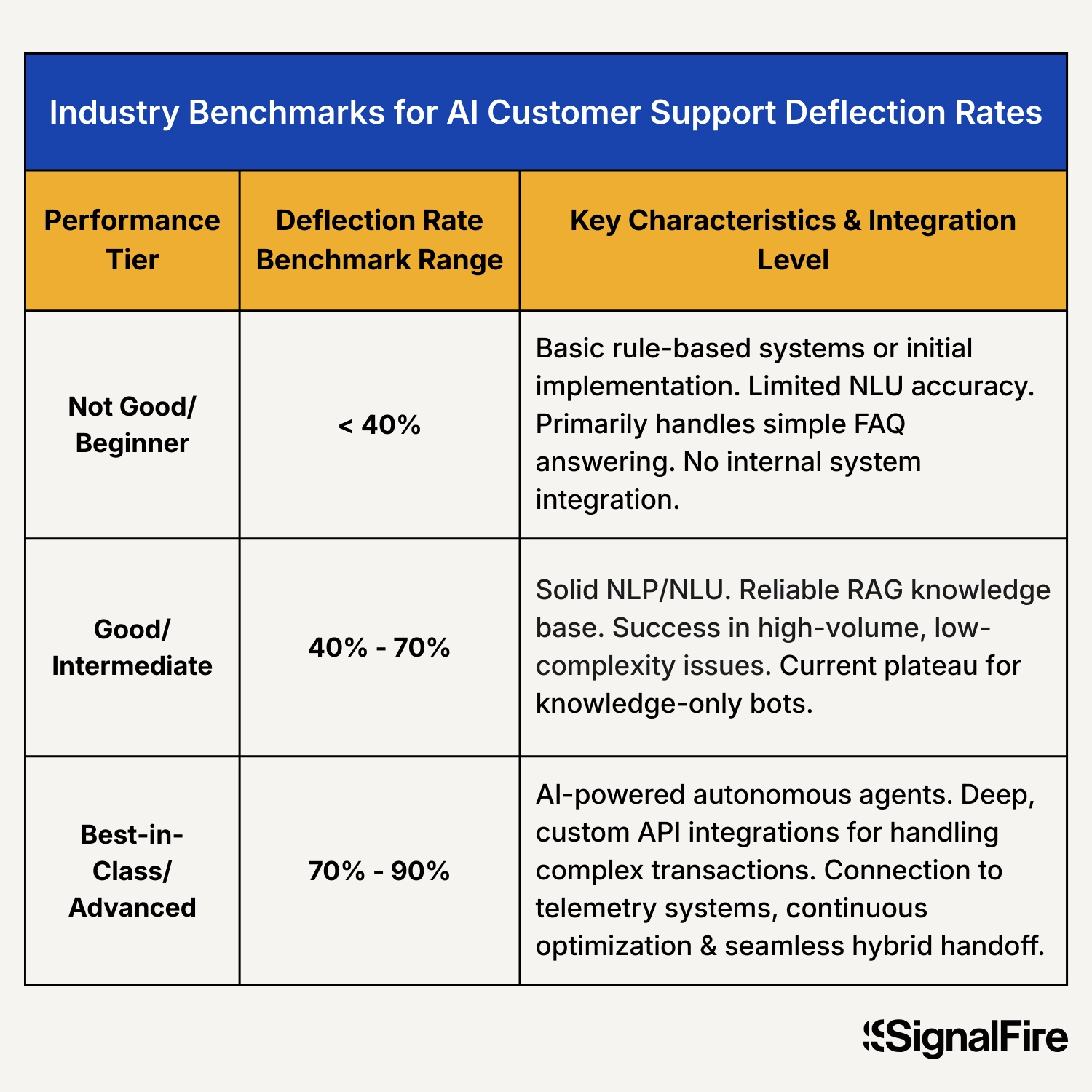
To escape the Intermediate performance tier (where the 50% resolution rate currently sits), organizations must benchmark against industry leaders who have integrated functional capabilities. The key metric is the Deflection Rate, which measures the percentage of issues resolved without requiring human escalation. Success requires a balanced KPI framework that includes Customer Experience (CSAT) and Operational Efficiency, as a high deflection rate is counterproductive if it traps frustrated customers.
The analysis of current industry performance shows a direct correlation between deflection rate and architectural sophistication.
Deepening technical triage (telemetry and observability)
Connecting to live data: This involves directly connecting the AI to telemetry systems, enabling the bot to synthesize technical documentation with real-time performance metrics and error logs. For technically proficient users, establishing trust requires the bot to reference the original data sources, including specific technical documents or telemetry readings, for verification. When an AI agent connects to telemetry, its function shifts from a CX tool to an IT Operations tool, capable of performing initial root cause analysis.
This integration supports a transition from reactive support to a proactive service model, anticipating customer needs and providing solutions before the customer even initiates contact. At Together AI, Sarung Tripathi notes that initial test results of directly connecting inference systems (where error/issue log data is stored) to support platforms and CX-defined runbooks are leading to the proactive resolution of API errors on its inference platform without human intervention.
Additionally, you can also look to integrate these tools with ticketing systems such as Linear and give it customer context through integrations with CRMs e.g., Salesforce
Orchestrating the hybrid experience - Defining when handoff should occur
Achieving Advanced-tier deflection (70%+ service automation) is the goal, but it naturally leaves only the most complex or sensitive cases for human agents. The overall success of your support strategy hinges on a seamless handoff that bridges AI efficiency with human empathy.
When to trigger a human handoff
Sophisticated handover triggers are key. They should move beyond simple failure and be based on contextual awareness, user intent, or sentiment analysis, detecting high frustration. However, you should also pre-program handoffs for specific situations:
- VIP/high-priority customers: For individuals or accounts with a guaranteed Service Level Agreement (SLA) or a promised level of service.
- Sensitive and regulated issues: Topics requiring a trained, certified, or legally authorized professional, especially in fields like financial services or legal practice.
- Agent incapacity or escalated frustration: Any instance where the AI agent explicitly cannot answer the question, or the customer's sentiment indicates they are significantly frustrated. According to Smith.ai, roughly 20% of AI-handled calls still involve callers explicitly requesting a human touch—often tied to emotional reassurance, complex situations, or higher-intent lead conversion.
The core requirement is context preservation
A successful handoff must be instant and invisible to the customer. The core requirement is context preservation: the complete interaction history must be transferred instantly to the human agent, preventing the customer from having to repeat their issue.
Upon transfer, assistive AI features must empower the human agent by providing:
- Real-time conversation summaries: A quick summary of the issue and steps already taken.
- Next-best action suggestions: Recommendations grounded in the case history and knowledge base.
The most effective support model is fundamentally hybrid, ensuring the efficiency gains of automation while guaranteeing a premium, empathetic experience when it matters most.
MarketMap of the top AI tools to consider for your customer service agent:
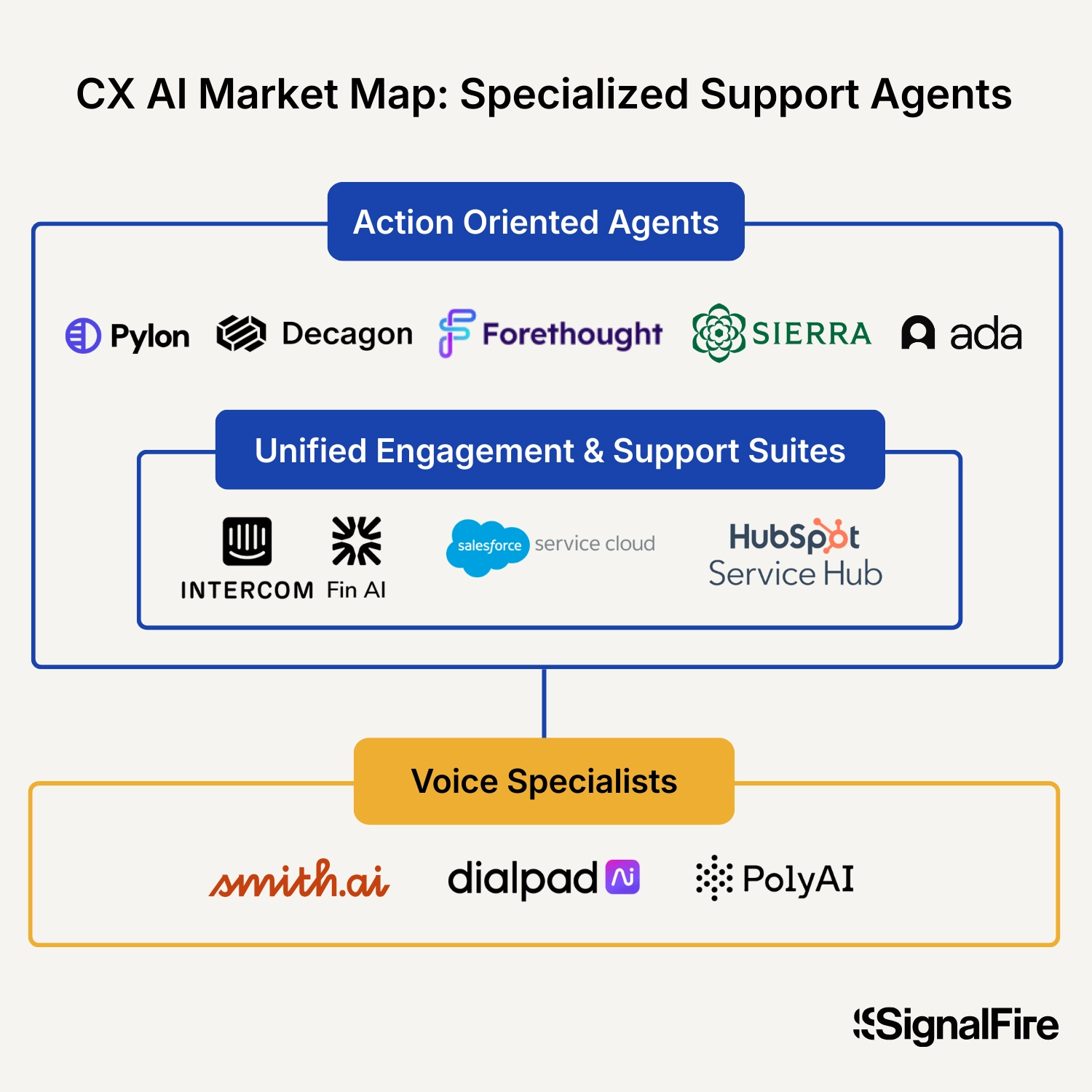
By strategically closing the API and telemetry gaps, organizations can have high-resolution rates (70% and above), ensuring the compounded ROI of truly autonomous customer service.
(This piece was co-authored by two members of the SignalFire community. Namrata Ram is a mentor with SignalFire, supporting founders with her GTM expertise and experience, while Stuart Watson is part of SignalFire’s Specialist Network, bringing domain-specific insights to help startups navigate their toughest challenges.)
___________
This article is part of SignalFire’s Practitioner’s Perspective Series, where seasoned operators and leaders share real-world, battle-tested insights to help founders sharpen their leadership, GTM execution, and scale strategies.
Through tools like Beacon AI for data-driven recruiting, and guidance from experts such as former Netflix Chief Talent Officer Tawni Cranz and former Stripe CMO Jim Stoneham, SignalFire provides founders with the operational support and strategic content they need at every stage of growth.

Namrata Ram
VP of Revenue Strategy & Ops at Together AI. Former VP of Revenue Strategy & Ops at Notion
Namrata Ram is the VP of Revenue Strategy & Operations at Together AI and former VP of Revenue Strategy & Operations at Notion.

Stuart Watson
Head of Revenue Operations, Resolve AI
Start Watson is the Head of Revenue Operations at Resolve AI. Before that he was the Director of Sales Operations at Spot AI. With 15+ years across sales leadership and RevOps, he has built and led teams from first hires to scale and uses AI to make small teams move like big ones.