The U.S. construction and home services (trades) market is a monolith, valued at approximately ~$2.1–$2.2 trillion annually, with a global market projected to reach ~$15 trillion by 2030. This industry is the bedrock of the American economy, but despite its colossal size, the specialty trades segment, which includes HVAC technicians, plumbers, electricians, and remodelers, continues to operate with little to no modern software, let alone AI.
With workflows still dominated by paper, phone calls, and PDFs sent over email, this category is primed for step-function productivity gains from AI agents and workflow automation.
We continue to believe that the next wave of defensible, high-margin SaaS winners will emerge from specialized Vertical AI solutions that convert the trades sector’s massive administrative waste into immediate, measurable profit, powered by various business models not confined to recurring annual contracts.
The structural opportunity - Targeting the administrative tax
The construction sector has been notoriously slow to adopt technology. In advanced manufacturing sectors, such as aerospace and automotive, companies invest 3.5%–4.5% of their revenue in R&D. In contrast, most construction firms still devote less than 1% to R&D and IT. This is digital debt, and we believe it’s about to be paid down rapidly by a new class of specialized, AI-driven tools.
The highest structural cost to address is labor, which accounts for 20% to 40% of total project expenses. For specialty trades like remodeling, where the complexity requires highly skilled personnel, labor costs can increase significantly beyond that range. However, the real opportunity isn’t lowering labor costs – it’s reducing the amount of skilled time that gets diverted away from revenue-generating work.
Construction remains among the least digitized industries, yet digital transformation can yield productivity gains of 14-15% and cost reductions of 4-6%2, opening the door for AI copilots and agents to drive immediate and measurable impact.
The 30% non-billable bottleneck
Our core target metric is the time spent by high-value, revenue-generating field technicians on non-billable tasks. Shockingly, technicians spend approximately 30% of their working hours on administrative tasks, including documentation, permit filings, and job briefs. For reference, this exceeds the 28% they spend on actually performing core services.
This 30% administrative tax is the highest leverage investment opportunity in the sector.
Any vertical AI solution that meaningfully automates or eliminates this friction provides an instant and high-margin ROI that is immediately quantifiable by the contractor. This simplicity and immediate value are crucial in driving adoption among a customer base where complexity, training, and cost are often cited as significant barriers. We’re looking to invest in companies that reclaim this 30% back into billable, profitable service delivery.
The customer and the low-friction imperative
Industry structure naturally favors the adoption of bottom-up wedges. The U.S. market comprises millions of small contractors, with over 6 million people employed in the specialty trades. These businesses tend to adopt tools that deliver immediate cash impact and require little to no behavior change.
We are specifically focused on small and medium-sized trade contractors. Not only do they make up the lion’s share of the market, but they are also driving the fastest growth in software adoption. What these contractors want are simple, low-friction tools that slot into existing workflows, not heavy, top-down systems built for large GCs.
What winning wedges in the trades actually require:
- Workflow-native: They plug into existing operational systems with minimal setup, avoiding the heavy integrations that often stall adoption across STCs.
- Integration-light: They’re designed to sit alongside (not replace) the existing FSM platforms that already anchor the business, allowing contractors to adopt without requiring behavioral change.
- Value-based: Pricing maps directly to labor or transaction-level savings and remains a fraction of the immediate, provable value created.
Products that meet these criteria tap into the largest spend categories in a contractor’s P&L – labor time and job-level transactions – not software budgets. When an AI tool eliminates administrative hours or accelerates revenue-driving tasks, the ROI is both immediate and recurring, which is why these products achieve high retention (LTV) and rapidly become indispensable to daily operations.
The top 3 high-ROI investment pools
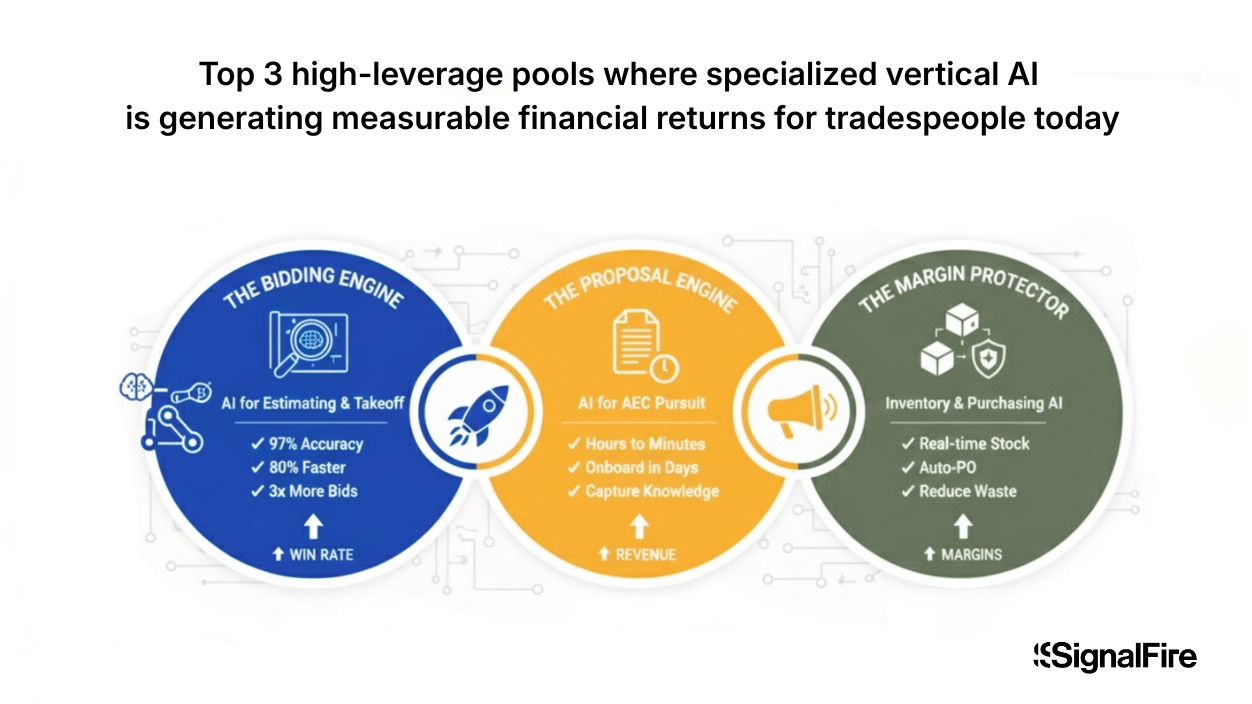
We see three immediate, high-leverage pools where specialized vertical AI is generating measurable financial returns for tradespeople today.
1. The bidding engine: AI for estimating and takeoff
Estimating is the financial gatekeeper of every trade and construction business, and in today’s market, it has become the chokepoint that determines who grows and who falls behind. As project pipelines tighten and win rates decline, contractors are being compelled to bid more frequently just to maintain their existing workload. That math compounds quickly: when win rates drop from ~25% to ~10%, firms must more than double bid volume simply to stay flat.
A single medium-sized commercial project can consume 40–60 hours of estimator time, and firms can’t hire their way out of this cost today. Skilled estimators are costly, and adding fixed overhead in a down market is often fatal. The result is a vicious cycle: more rushed bids, more errors, weaker pricing discipline, and further erosion of margins.
AI is breaking this cycle by fundamentally changing the economics of bidding. Modern takeoff systems deliver a dual value proposition:
- Accuracy: Automated takeoff systems can interpret plans with up to 97% accuracy, virtually eliminating the need for large contingency buffers that result from human error
- Speed: AI can automate up to 80% of the manual takeoff process, saving estimators roughly 90 minutes per sheet and enabling contractors to bid on 2–3x more jobs with the same team
This shift turns estimating from a slow, error-prone cost center into a leveraged growth engine. Contractors can produce higher-quality bids in greater volume at a lower cost. This creates a structural advantage over competitors who are still performing manual takeoffs. In a tight market, that advantage compounds: more at-bats, better pricing discipline, and a meaningfully higher win rate.
2. The proposal engine: AI for AEC pursuit and revenue operations
In the Architecture, Engineering, and Construction (AEC) industry, the proposal function is the closest thing to a revenue factory. Firms win or lose work based on the quality and speed of what their marketing and pursuit teams can produce. Yet the process remains one of the most fragile workflows in the industry: scattered InDesign files, outdated resumes, inconsistent project data, and a heavy dependence on the institutional knowledge of a few long-tenured specialists.
As competition intensifies and firms chase more opportunities, this bottleneck becomes impossible to ignore. Proposal teams are asked to do more with the same headcount, and the cracks show in the form of slower turnaround times, inconsistent messaging, and rising burnout as individuals carry decades of unwritten knowledge.
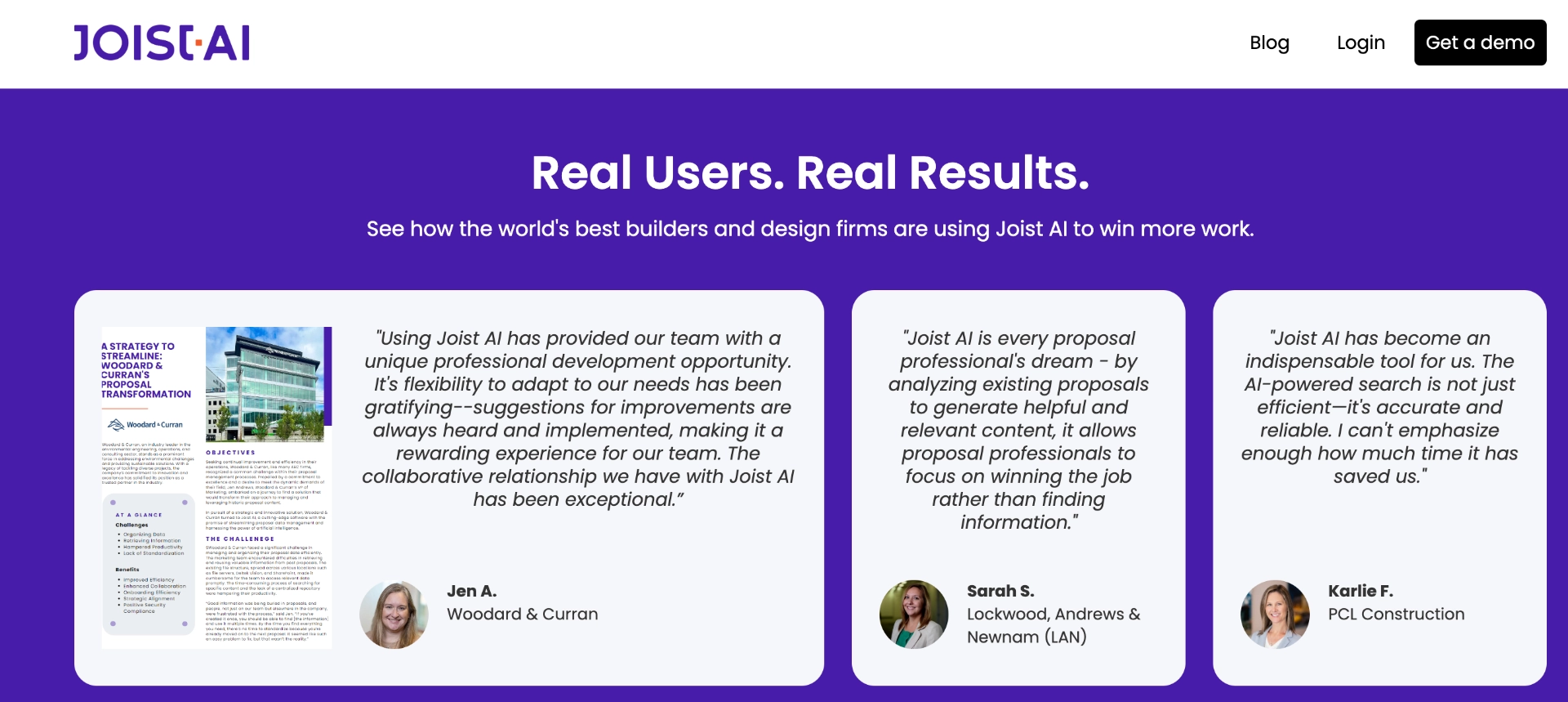
Our portfolio company, Joist, turns this into a structured, repeatable, and AI-powered workflow. By connecting directly to a firm’s systems of record, Joist surfaces the right resumes, project histories, compliance checks, and boilerplate instantly – compressing proposal creation from hours to under an hour. Teams report onboarding new hires in days instead of months, and for the first time, are capturing institutional knowledge that would otherwise be lost with a single employee departure.
As workload and competition increase across the AEC sector, this kind of automation is shifting from a productivity boost to a core part of the revenue engine.
3. The margin protector: Inventory and purchasing AI
For most trade contractors, materials are the largest and least controlled cost center. Stockouts, over-ordering, and disconnected supplier workflows result in downtime for technicians and unnecessary expenses for the business. These inefficiencies are directly reflected in lost billable hours and thinner margins.
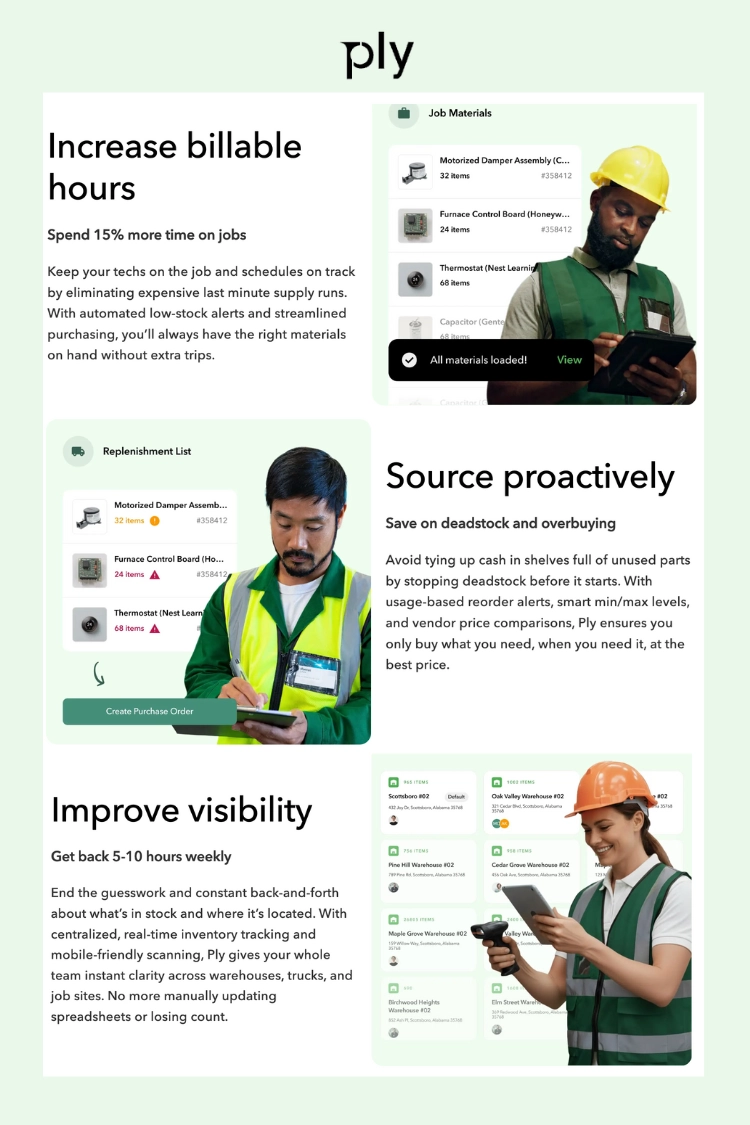
SignalFire portfolio company Ply addresses this by providing contractors with real-time visibility into inventory across warehouses and trucks, and then tying that directly to purchasing. Barcode scanning, synced stock locations, and job-linked demand ensure teams know what they have and what they need. As soon as contractors begin running purchase orders through Ply, the product becomes an integral part of their daily workflow and quickly becomes a system they rely on.
The step-change comes from supplier integrations. Ply embeds distributor catalogs directly into the platform, allowing contractors to generate accurate purchase orders in one place. This reduces back-and-forth communication, prevents over-ordering, and keeps technicians focused on revenue-generating work. Deep integrations with FSM systems and distributor networks create a unified workflow that connects technicians, inventory, and purchasing in one place.
As businesses scale into multi-location operations, manual inventory and purchasing become untenable. Ply turns these brittle workflows into a predictable system that improves labor productivity, controls material spend, and protects margins across the entire fleet.
The model: Building data moats and strategic exits
For investors, the long-term defensibility of this vertical AI wave hinges on proprietary data and strategic positioning.
The data moat of specialization
Horizontal LLMs struggle with the nuance of specialty trades. Every electrical code, every HVAC unit specification, and every vendor price list is unique to that trade. Companies that specialize in a single trade can collect a proprietary, vertically specific data set that is virtually impossible for a generalized competitor to replicate with sufficient accuracy. This superior data translates directly into higher predictive value, which reinforces contractor trust and drives increased daily usage.
Vertical AI for the trades - Where we focus
The construction and trades ecosystem is deeply fragmented, with workflows spread across point solutions, spreadsheets, aging desktop tools, and a handful of heavyweight platforms that were never built for the realities of the specialty trades. Breakout products don’t begin as “all-in-one” systems. They win by fixing one mission-critical problem better than anything else, then expanding once the team has come to depend on them.
Across the market, we’re seeing a clear pattern: the teams that break out start with a focused wedge, deliver unmistakable ROI on day one, and expand only once they become part of the firm’s operating rhythm.
What we look for:
- Deep vertical focus: Focus on a single trade (HVAC, plumbing, electrical) to build deep, trade-specific data moats
- Low-friction adoption: Tools that slot into existing processes with minimal setup and no workflow overhaul; adoption should be driven by immediate relief, not heavy onboarding
- Measurable ROI: A clear link to reclaimed labor time, reduced rework, improved throughput, or better margin discipline, not vague “efficiency.”
- Workflow-native integrations: Solutions designed to work alongside the FSMs and systems contractors already rely on, enabling distribution leverage and long-term stickiness
The next generation of compounders in the trades won’t be defined by seat count. They’ll win by running core workflows, automating the tasks that operators perform daily, and positioning themselves at the intersection of labor, materials, and finances. That’s the layer we’re backing. After decades of underinvestment, the trades are ready for a step-change in productivity, and vertical AI will drive it. We support founders who pair deep field insight with the conviction to re-architect this ecosystem. Now is the time to build – early leaders are already emerging, and their advantage will compound quickly.
If you’re building in this space, we want to hear from you. Email us at wayne@signalfire.com or varun@signalfire.com.
___________________________________
Data Sources:
1. U.S. Census Bureau - Monthly Construction Spending Nov. 2025
2. McKinsey Global Institute Report - Reinventing construction through a productivity revolution
3. Construction Coverage - U.S. Construction Industry Facts, Stats & Trends
4. Gorgian - Construction Cost Insights Report: Q2 2024

Wayne Hu
Partner
Wayne joined SignalFire to help form the initial investment team in 2015, and leads seed stage investments focused on consumer, emerging technology platform shifts, and historically innovation-sparse sectors that can be reinvented end-to-end.

Varun Ramakrishnan
Principal
Varun is a Principal who joined SignalFire in 2024 focused on venture and growth-stage software investments. Prior to joining SignalFire, Varun spent ~3 years at General Atlantic in New York & San Francisco where he invested in growth-stage and pre-IPO enterprise software and companies globally.